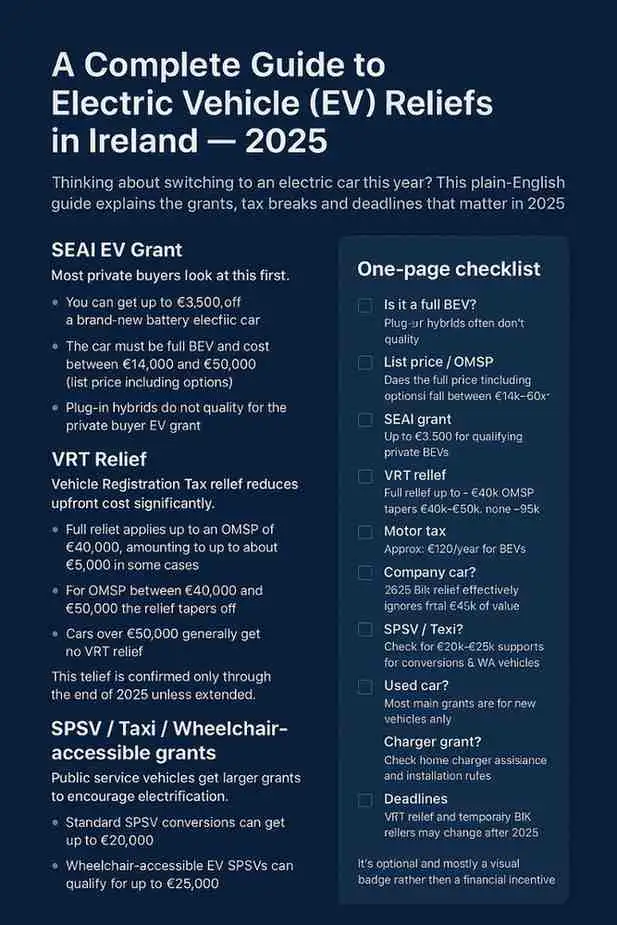
If you're looking into EV reliefs in Ireland, you've probably noticed the rules keep changing. One year the relief is EUR5,000, the next year there's talk of cutting it. It's confusing, and it makes planning an import or purchase harder than it needs to be.
In this guide I'll walk through the full history of EV VRT relief in Ireland, how it's evolved, how the tapering works, which vehicles qualify, what paperwork you need, and what I think will happen next. Whether you're buying your first EV or your fifth, this will help you understand where the system has been and where it's going.
What Frustrates People About EV Reliefs
Let's start with the problems, because if you've tried to figure this out before, you've probably run into them.
The relief keeps changing. The EV relief has been extended, modified, reduced, and threatened with cancellation more times than I can count. Every budget brings uncertainty. You never know if next year's relief will be the same, lower, or gone entirely.
The rules are scattered. The VRT relief rules are on Revenue. When you book your VRT inspection, you will visit an NCTS (National Car Testing Service) centre, where they verify your vehicle's details before registration.ie. The SEAI grant rules are on a completely different website. The motor tax rules are somewhere else. Nobody has brought it all together in one place, which is why I wrote this.
The tapering catches people out. You hear "EUR5,000 relief" and assume you're getting the full amount. Then you buy a car with an OMSP of EUR44,000 and find out the relief is reduced. The tapering formula isn't well explained, and it's easy to miss.
Documentation requirements are strict. Revenue wants specific paperwork, and if you don't have it, your application gets delayed. Missing a Certificate of Conformity or the wrong invoice can set you back weeks.
Right, with that out of the way, let's look at the history.
The Full History of EV VRT Relief in Ireland
EV VRT relief hasn't always existed. It was introduced as part of Ireland's push to get more electric vehicles on the road. Here's the timeline:
2019: The EV VRT relief was introduced at EUR5,000. The idea was simple: make EVs cheaper to register, and more people will buy them. At the time, EVs were a tiny fraction of new car sales, and the government wanted to kickstart the market.
2020: The relief continued unchanged. COVID disrupted car sales, but the relief stayed in place. The government also introduced the SEAI grant at EUR5,000, giving buyers up to EUR10,000 in total incentives.
2021: Still EUR5,000 VRT relief. The reduced EV VRT rate of 6% was also confirmed. EV sales started to pick up sharply.
2022: The SEAI grant was cut from EUR5,000 to EUR3,500. The VRT relief held at EUR5,000. This was the first sign that the government was starting to reduce incentives as EV adoption grew.
2023: No major changes to VRT relief. The SEAI grant stayed at EUR3,500. Budget 2024 confirmed the VRT relief would continue through 2026. This was welcome news, but it also raised the question: what happens after 2026?
2024: The VRT relief was confirmed to continue through the end of 2026. The BIK relief for company cars was at its peak, with EUR45,000 excluded from the BIK calculation. The EV market share continued to grow, reaching about 20% of new car sales.
2026: BIK relief reduced to EUR20,000 for 2026 (and EUR10,000 for 2027). The VRT relief was due to expire at the end of 2026, but was extended through 2026. The SEAI grant stayed at EUR3,500.
2026: VRT relief extended through the end of 2026 at EUR5,000. The 6% VRT rate maintained. SEAI grant unchanged. But the writing is on the wall: every year the incentives get reviewed, and the trend is toward reduction.
What's clear from this timeline is that the government has been gradually reducing EV incentives as adoption increases. The SEAI grant was cut early. The BIK relief is being phased down. The VRT relief has held longer than expected, but it's unlikely to survive at EUR5,000 beyond 2026.
How the Relief Has Reduced Over Time (and the EUR5,000 Question)
The EUR5,000 figure has been remarkably stable for VRT relief, but when you look at the bigger picture, the total incentive package has shrunk a lot.
In 2019, a new EV buyer could get:
- EUR5,000 VRT relief
- EUR5,000 SEAI grant
- EUR120 motor tax
- Generous BIK relief (company cars)
- Home charger grant
- Total first-year benefit: roughly EUR12,000 to EUR15,000 depending on the car
In 2026, the same buyer gets:
- EUR5,000 VRT relief (but only on cars under EUR50,000)
- EUR3,500 SEAI grant
- EUR120 motor tax
- Reduced BIK relief (EUR20,000 exclusion vs EUR45,000)
- Home charger grant (still available)
- Total first-year benefit: roughly EUR9,000 to EUR11,000
The total incentive has dropped by about 25% to 30% since the peak. That's real money gone. And if the VRT relief is reduced after 2026, that figure will drop further.
Why has this happened? The government's logic is that as EVs become more affordable and the charging infrastructure improves, the need for subsidies decreases. EV prices have come down, especially in the used market. Range has improved. The argument that EVs are too expensive or impractical is weaker than it was in 2019.
Whether you agree with that logic depends on your perspective. EV prices are still higher than equivalent petrol cars, and the charging network, while improving, still has gaps. But the direction of travel is clear: incentives are being reduced, not increased.
The Tapering Mechanism Explained in Detail
The tapering mechanism is one of the most misunderstood parts of the EV relief system. Let me explain it properly.
The full EUR5,000 relief is available on BEVs with an OMSP of EUR40,000 or less. For cars with an OMSP between EUR40,000 and EUR50,000, the relief is reduced by 50% of the amount over EUR40,000.
The formula is: Relief = EUR5,000 - ((OMSP - EUR40,000) x 0.5)
Here's how it plays out across different price points:
- OMSP EUR40,000: Relief = EUR5,000 (full amount)
- OMSP EUR42,000: Relief = EUR5,000 - (2,000 x 0.5) = EUR4,000
- OMSP EUR44,000: Relief = EUR5,000 - (4,000 x 0.5) = EUR3,000
- OMSP EUR46,000: Relief = EUR5,000 - (6,000 x 0.5) = EUR2,000
- OMSP EUR48,000: Relief = EUR5,000 - (8,000 x 0.5) = EUR1,000
- OMSP EUR50,000: Relief = EUR5,000 - (10,000 x 0.5) = EUR0
What this means in practice is that every EUR1,000 over EUR40,000 costs you EUR500 in lost relief. If you're negotiating the price of a car, or choosing optional extras, keep this in mind. Pushing the OMSP from EUR39,500 to EUR40,500 costs you EUR250 in relief. From EUR40,000 to EUR45,000 costs you EUR2,500.
I've seen people add EUR2,000 in optional extras to a EUR39,000 car, pushing the OMSP to EUR41,000, and losing EUR500 of the relief. That's a net loss of EUR500 for EUR2,000 worth of extras. Sometimes it's better to skip the extras and keep the relief.
Which Vehicles Qualify for the Relief
Not every car with a plug qualifies. Here's the definitive list:
Qualifying vehicles:
- Full Battery Electric Vehicles (BEVs) - pure electric, no internal combustion engine
- Hydrogen fuel cell vehicles (very rare in Ireland, but technically qualify)
- Electric motorcycles (series production, currently VRT-exempt)
- Electric mopeds (subject to their own exemption rules)
Non-qualifying vehicles:
- Plug-in Hybrid Electric Vehicles (PHEVs) - even with very low CO2 figures
- Self-charging hybrids (HEVs) - no plug, no electric range
- Mild hybrids (MHEVs) - these are essentially petrol cars with a small battery
- Range-extended EVs (REEVs) - these are technically BEVs with a generator, but check with Revenue
The key test is whether the vehicle can operate without emitting any tailpipe emissions. If it has an internal combustion engine that can propel the wheels, it doesn't qualify for the EV relief. This is true even for PHEVs that can do 50 km on electric power.
To qualify, the vehicle must also be type-approved as a BEV. You can check this on the Certificate of Conformity, which will list the vehicle category and fuel type. If it says "Electric" or "BEV" in the fuel type field, you're good. If it says "Petrol/Electric" or "Hybrid," you won't get the relief.
The OMSP must also be under EUR50,000. This is based on Revenue's assessment, not the purchase price. For new cars, the OMSP is usually close to the list price. For used cars, Revenue uses guide prices that may differ from what you paid.
Documentation You Need for VRT Relief
Getting the relief requires proper paperwork. Here's what you'll need:
Certificate of Conformity (CoC): This is the most important document. It proves the vehicle meets EU standards and shows the fuel type, CO2 emissions, and other technical details. For new cars, the dealer provides this. For used imports, you'll need to get it from the manufacturer or an authorised dealer. Some manufacturers charge for this, so factor in the cost.
Proof of purchase: The invoice or receipt showing what you paid for the car. Revenue will use this as part of their OMSP assessment, but it's not the only factor. For imports, you'll also need the foreign registration document (V5C for UK cars).
NCT or equivalent: Before you can register the car, you need proof it's roadworthy. For UK imports, a valid UK MOT may be accepted if it's less than 12 months old. Otherwise, you'll need an Irish NCT.
Customs documentation: For imports from outside the EU, you'll need customs clearance documents showing VAT has been paid. For GB imports, this means the C21 form or equivalent.
Vehicle details: Make, model, year, VIN, engine size, fuel type, CO2 emissions, and odometer reading. You'll enter these when submitting the VRT return online.
Proof of address and identity: Revenue will need your PPS number, address, and identification. This is standard for any VRT registration.
My advice: gather all the paperwork before you submit the VRT return. Missing documents can delay the process by weeks. If you're importing, start collecting documents as soon as you buy the car, not when it arrives in Ireland.
Combining VRT Relief with SEAI Grants
One of the best things about the Irish incentive system is that VRT relief and SEAI grants can be combined. You don't have to choose one or the other.
Here's how they work together:
The SEAI grant is applied at the point of sale by the dealer. You don't need to claim it yourself. The dealer reduces the purchase price of the car by the grant amount, and SEAI reimburses the dealer. For private buyers, the grant is EUR3,500 for BEVs with a list price between EUR14,000 and EUR60,000.
The VRT relief is applied when you register the car. Revenue calculates the VRT at 6%, then subtracts the relief (up to EUR5,000). If the relief is larger than the VRT, you pay nothing. If it's smaller, you pay the difference.
To get both:
- Buy a qualifying BEV from a registered dealer (for the SEAI grant)
- Make sure the OMSP is under EUR50,000 (for the VRT relief)
- Submit the VRT return with all required documentation
- The dealer handles the SEAI grant separately
For a typical EUR35,000 BEV, this means:
- SEAI grant: -EUR3,500 (from purchase price)
- Price after grant: EUR31,500
- VRT at 6% on OMSP of EUR33,000: EUR1,980
- VRT relief: EUR1,980 (reduced to zero)
- Total VRT payable: EUR0
- Total upfront saving: EUR5,480 (EUR3,500 SEAI + EUR1,980 VRT)
Plus you can still claim the home charger grant (EUR600) separately. Combined, the total incentive package is worth over EUR6,000 on a typical family EV.
Predictions for Future Relief Changes
I'm not a government insider, but I've been watching this space for years, and I have some thoughts on what's coming.
Short-term (2026-2027): The VRT relief will likely be extended in some form, but probably at a reduced level. I'd expect EUR3,000 to EUR3,500 for 2027, with a lower OMSP threshold (maybe EUR35,000 for full relief). The 6% VRT rate might start increasing, possibly to 8% or 10%. The SEAI grant will probably stay at EUR3,500 for another year or two.
Medium-term (2028-2029): The VRT relief will likely be eliminated or reduced to a token amount. The 6% rate will probably increase to something closer to the standard CO2-based rates. The SEAI grant may be reduced to EUR1,000 or EUR1,500.
Long-term (2030+): By 2030, if EV market share is high enough, most incentives will be gone. EVs will be taxed similarly to conventional cars. Motor tax for EVs will probably increase from EUR120 to something more substantial.
This is my best guess based on the trends. The government has been clear that incentives are temporary and will be phased out as the market matures. The only question is the speed of the phase-out.
What this means for you: if you're considering an EV, don't wait. The incentives are better now than they will be in two or three years. Every year you delay, the total incentive package is likely to be smaller.
Real-World Example: Relief Changes Over Five Years
Let me show you how the incentive package has changed by looking at the same car across different years.
2020: Nissan Leaf (EUR30,000 list price)
- SEAI grant: EUR5,000
- VRT relief: EUR5,000
- VRT rate: 6%
- VRT payable: EUR0 (relief covers all)
- Total upfront saving: EUR10,000
2023: Nissan Leaf (EUR30,000 list price)
- SEAI grant: EUR3,500 (reduced)
- VRT relief: EUR5,000
- VRT payable: EUR0
- Total upfront saving: EUR8,500
2026: Nissan Leaf (EUR30,000 list price)
- SEAI grant: EUR3,500
- VRT relief: EUR5,000
- VRT payable: EUR0
- Total upfront saving: EUR8,500
For the affordable Leaf the buyer experience hasn't changed much since 2023. The SEAI reduction was the main hit. But for a more expensive car like a Tesla Model 3 the picture is different. In 2020 you got full relief on a EUR50,000 car. In 2026 that same car sits in the taper zone and the relief is reduced. The total incentive has dropped by EUR1,500 to EUR2,000 depending on the exact spec.
This matters because car prices have gone up. The average new car price in Ireland is now over EUR40,000. Many popular EVs like the Tesla Model 3, Volkswagen ID.4, and Hyundai Ioniq 5 are priced in the taper zone. Buyers of these cars are getting less relief than they would have a few years ago.
Frequently Asked Questions
Can I get VRT relief on a used EV? Yes, the relief applies to both new and used BEVs, as long as the OMSP is under EUR50,000. Most used EVs qualify.
What happens if the VRT relief expires? If the relief is not extended, EVs would pay the standard 6% rate with no relief. That would mean most EVs would pay EUR2,000 to EUR4,000 in VRT instead of zero.
Can I combine the VRT relief with the SEAI grant? Yes, they're separate incentives and both apply. The SEAI grant reduces the purchase price, and the VRT relief reduces the registration tax.
Does the relief apply to EVs imported from the UK? Yes, as long as the car is a qualifying BEV and the OMSP is under EUR50,000. The relief doesn't discriminate based on where the car was purchased.
What documents do I need to prove the car is a BEV? The Certificate of Conformity showing the fuel type as "Electric" is the standard proof. For some imports, a letter from the manufacturer may be accepted.
Is the relief automatically applied? No, you need to submit the VRT return and Revenue will calculate the relief based on the information you provide. Make sure all your documents are in order.
What happens if Revenue's OMSP is higher than what I paid? The VRT relief is based on Revenue's OMSP, not your purchase price. If the OMSP is over EUR50,000, you don't get relief even if you paid less. You can appeal the OMSP assessment if you think it's wrong.
Appealing Revenue's OMSP Assessment
If Revenue values your car higher than you think it's worth, you can appeal. Here's how:
Step 1: Get the OMSP assessment from Revenue after submitting your VRT return. You have 14 days to appeal from the date of assessment.
Step 2: Gather evidence ads for similar cars, a dealer valuation, or a professional appraisal. The more evidence the stronger your case.
Step 3: Submit your appeal in writing explaining why the OMSP is too high. Revenue will review and either adjust or uphold their assessment.
Step 4: If Revenue upholds the assessment you can appeal to the Tax Appeals Commission. This is more formal and may need professional advice.
Revenue does adjust OMSPs in some cases particularly if you provide strong evidence. For EVs battery degradation on older cars can be a factor. A battery health report from a dealer can help your case. It's worth trying.
Tips for Maximizing Your Relief
Based on everything I've covered here are my top tips:
- Keep the OMSP under EUR40,000 if possible. This gives you the full EUR5,000 relief. Every euro over costs you 50 cent in lost relief.
- If you have to go over EUR40,000 understand the cost. A car at EUR45,000 costs you EUR2,500 in lost relief compared to one at EUR40,000.
- Don't buy over EUR50,000 if you want relief. Above EUR50,000 you get nothing. Look at a different model or a used version.
- Apply for the home charger grant at the same time. It's a separate SEAI application and takes a few weeks.
- Check SEAI eligibility before you buy. The list price must be between EUR14,000 and EUR60,000 including options.
- Get the OMSP in writing before you commit. Ask the dealer or use the Revenue ROS enquiry tool.
Final Thoughts
The EV VRT relief in Ireland has been a success story. It helped drive EV adoption from virtually nothing in 2019 to over 20% of new car sales in 2026. But all good things come to an end, and the relief is clearly on the way out.
If you're in a position to buy an EV, 2026 is probably the last year you'll get the full EUR5,000 relief. From 2027 onwards, expect lower relief, higher rates, and fewer incentives. That doesn't mean EVs won't be worth buying - they'll still have lower running costs and lower motor tax. But the upfront savings won't be as generous.
My advice: do your research, gather your documents, and if the numbers work for you, don't put it off. The relief isn't going to get better.