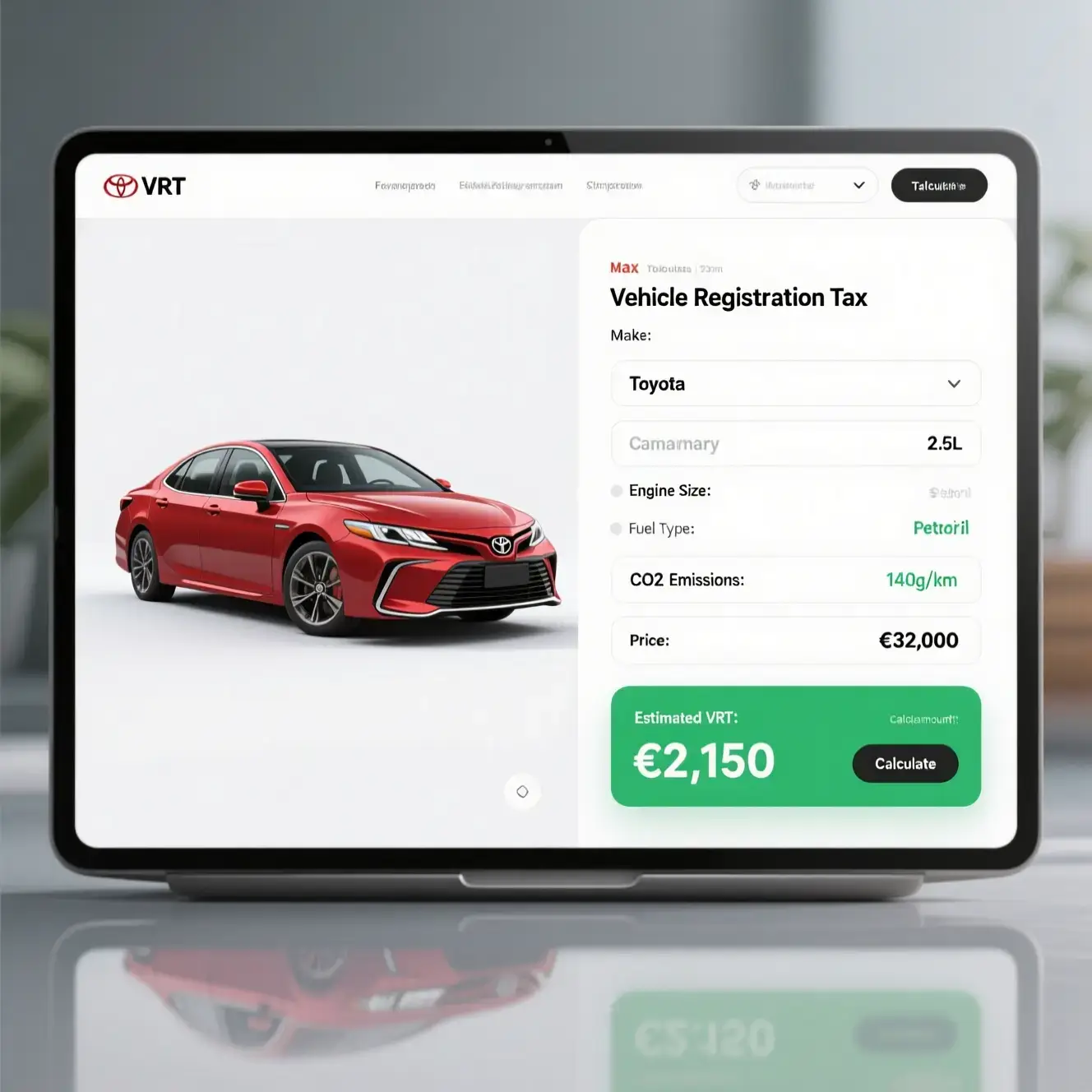
There's a 2018 Audi A4 Avant parked on a dealer forecourt in Belfast. The price tag says £10,995. The paint is good, the interior is clean, and it's got the 2.0 TDI engine you've been looking for. You're already picturing it on the M50. But here's the question that separates a good import from a financial disaster: how much VRT will you pay when you bring it home?
I've been in that situation more times than I can count. You get excited about the car, you negotiate the price, and then you realise you have no idea what the total landed cost will be. VRT, customs duty, VAT, VRT on top of VAT, shipping, NCT. It all adds up fast.
This guide is about one thing: how to check the VRT cost before you buy. Not after. Before. So you know exactly what you're signing up for and you don't end up with a car that costs more to register than it's worth.
The Problem with Buying First and Checking Later
I'll give you a real example. A friend of mine bought a 2016 BMW 5 Series from a dealer in Northern Ireland. The car was £9,000, which felt like a steal compared to Irish prices. He drove it down to the VRT office in Dublin, handed over the paperwork, and waited for the assessment.
The VRT came back at €5,200. Then customs duty at 10% on the purchase price added another €900. Then VAT at 23% on the customs-included value plus VRT. By the time he added shipping, NCT, and the registration fee, the total import cost was over €8,000 on a car he'd bought for €10,500 equivalent. The total landed cost was close to €19,000. He checked DoneDeal and found the same car already registered in Ireland for €17,500.
He lost money on that deal. And he made that loss because he didn't check the VRT before he bought the car. Don't be my friend.
The point is not that importing is always a bad idea. It's that you need the full picture before you commit. Some cars make great imports. Others are a trap. The difference is knowing how to check.
I've seen people walk into a VRT office with a car they bought on a whim and come out an hour later with a bill for €4,000 that they didn't see coming. They had the money, but they were angry about it because they felt misled. The truth is, the information was available. They just didn't look for it before they bought. Don't let that be you.
Over the years, I've developed a system for checking VRT before buying. It takes about 20 minutes per car, and it has saved me and the people I've helped thousands of euro. I'm going to share that system with you in this guide.
Where to Start: The Three Numbers You Need
Before you even look at shipping quotes or insurance, you need three numbers for any car you're considering. Without these, you're flying blind.
Number 1: CO2 Emissions
The car's CO2 figure determines the VRT rate. Under 120 g/km WLTP means you pay 8% of the OMSP. Over 120 g/km means you pay 13.3%. That might not sound like a huge difference, but on a €20,000 car, it's over €1,000.
You can find the CO2 figure on the Certificate of Conformity, the UK Government vehicle enquiry page (using the reg number), or sometimes in the online advert itself. UK dealers are required to display CO2 information for most cars, but they often use the old NEDC figure rather than the WLTP one. If in doubt, ask for the WLTP figure specifically.
Number 2: NOx Emissions
The NOx figure determines the NOx levy. This is a separate charge on top of the CO2 component, and it catches a lot of people off guard. The figure is in mg/km, and you'll usually find it on the Certificate of Conformity.
Diesel cars tend to have higher NOx figures than petrols, which is why diesel imports are often more expensive to register than equivalent petrols. A diesel with NOx of 80 mg/km will pay €2,200 in NOx levy alone (before the cap). A petrol with 30 mg/km pays €150. That's a €2,050 difference.
Number 3: Irish Market Value (OMSP)
This one is trickier because you can't look it up in a database. The OMSP is Revenue's assessment of the car's value on the Irish market, not what you paid for it. You need to estimate it yourself. Search DoneDeal and CarsIreland for the same model, year, engine, and trim level. Average the prices you find, and adjust for mileage and condition.
If you get this number wrong, your entire VRT estimate will be off. Be realistic, not optimistic. And don't fall into the trap of thinking the OMSP will match the UK purchase price. I've seen cars bought for £8,000 in the UK get an OMSP of €13,000 in Ireland because the model is rarer here and commands a premium. The VRT on that difference alone can be €600 or more.
Here's a practical tip. When you search DoneDeal, look at the cars that haven't sold. The listings that have been up for a few weeks with price drops are a better indicator of the real market value than the freshly listed optimistically-priced ones. Revenue's database is based on actual sales and dealer listings, so it tends to reflect what cars are actually selling for, not what sellers are asking.
Using the VRT Calculator to Check Before You Buy
The fastest way to check VRT on a car before committing is to use a VRT calculator. Our free calculator gives you an instant estimate based on the OMSP, CO2, and NOx figures you enter. The more accurate your inputs, the more accurate the result.
Here's how I recommend using it:
- Find the CO2 and NOx figures for the car (from the CoC or an online lookup).
- Estimate the OMSP by searching DoneDeal for similar cars in Ireland.
- Enter all three numbers into the calculator.
- Note the result, then add 10% as a buffer for Revenue's OMSP being slightly higher than your estimate.
- That's your realistic VRT budget.
Do this for every car you're considering. You'll quickly see which ones make financial sense and which ones don't.
Checking Revenue's OMSP Database
Revenue doesn't publish a public OMSP database, which makes it hard to know the exact figure they'll assign. But there are ways to get a good idea.
Use the VRT Enquiry System
If you have the VIN or registration number, you can submit a VRT enquiry through Revenue's ROS system or through a VRT agent. This gives you a preliminary assessment of the VRT due. The number isn't binding you can still appeal it but it's Revenue's own initial estimate, which is more reliable than guessing.
The catch is that you need to be the registered importer or have a VRT agent acting on your behalf. You can't just submit an enquiry for any car. But if you're serious about a specific car, it's worth paying a VRT agent a small fee to get this done.
Look at Recent Assessments for Similar Cars
There are forums and Facebook groups where people share their VRT assessment results. Boards.ie has a long-running thread where people post their car details and the VRT they paid. Search for your specific model and see what others paid. It's not official, but it gives you a real-world data point.
Just keep in mind that two similar cars can get different OMSPs based on condition, mileage, and optional extras. A 2019 Golf R-Line with 30,000 km and full service history will have a higher OMSP than the same model with 80,000 km and a missing service book.
How Condition Affects the OMSP
Revenue doesn't just look at the model and year. They consider the car's condition when setting the OMSP. This is one area where you can influence the outcome by being honest and thorough in your VRT return.
If you're importing a car with visible damage, high mileage, or mechanical issues, make sure you document it. Take photos of every scratch, dent, and worn tyre. If the service history is missing, note that too. Revenue will reduce the OMSP if the condition is below average, but they need evidence.
On the flip side, if the car is in exceptional condition, expect a higher OMSP. A low-mileage, one-owner car with full main dealer history will sit at the top of the valuation range.
Here's a rough guide to how condition affects OMSP in Revenue's system:
- Excellent condition: Full OMSP (100% of the database value)
- Good condition: About 95 to 100% of the database value
- Average condition: About 85 to 95% of the database value
- Below average condition Significant damage, high mileage: 70 to 85% of the database value
These aren't official Revenue percentages, but they reflect how the system generally works in practice.
VRT on Irish Cars That Have Already Been Registered
If you're buying a car that's already registered in Ireland, the VRT has already been paid. You don't need to calculate it again. But you should still check that the VRT was paid properly.
Ask the seller for the Vehicle Registration Certificate. If they can't produce it, or if the car was recently imported from the UK by a private seller, do some digging. There have been cases where people imported cars, didn't pay the full VRT, and then sold them on. The liability stays with the car, not the owner. So if you buy a car that VRT wasn't paid on, Revenue can come after you for the outstanding amount.
You can check the VRT status through the National Vehicle and Driver File (NVDF). If the car has a valid Irish registration and the VRT is marked as paid, you're safe. If there's any doubt, ask the seller to provide proof or walk away.
Budgeting for the Total Cost of Importing
VRT is the biggest cost, but it's not the only one. Here's a complete budget for a typical import from Great Britain to Ireland:
Purchase Price
This is what you pay the seller. Convert to euro at the current exchange rate. Don't forget to add at least 5% for exchange rate fluctuations.
Shipping and Transport
Getting the car from the UK or NI to Ireland costs anywhere from €150 (if you drive it yourself on a ferry) to €600 (if you use a transporter). If you're importing from mainland Europe, expect higher costs.
Customs Duty (10%)
For cars imported from Great Britain (not NI), you pay 10% customs duty on the purchase price plus shipping. So if the car cost €10,000 and shipping was €300, duty is 10% of €10,300 = €1,030. Cars from Northern Ireland and the EU are exempt from customs duty under the current trade arrangements.
VAT (23%)
VAT is charged on the total of: purchase price + shipping + customs duty. So using the same numbers: (€10,000 + €300 + €1,030) = €11,330. 23% of €11,330 = €2,606.
And here's the part people forget. VRT itself is also subject to VAT. So Revenue calculates VAT on the customs value including the VRT amount. Your total VRT figure is added to the taxable value before VAT is applied. This means the VRT effectively attracts VAT, which increases the total cost further.
VRT (Calculated Separately)
This is what you've come here to figure out. Use the VRT calculator or follow the steps in this guide to estimate it.
NCT (National Car Test)
Imported cars need an NCT before they can be registered. The test costs €55, and if any work is needed, budget extra. Most imports from the UK and NI need some minor work to pass, even if they came with a valid MOT. Headlight alignment and tyre condition are common issues.
Registration Fee
Revenue charges a registration fee of about €125 for processing the VRT and issuing the Irish registration certificate and plates.
Total Cost Example
Let's put it all together for a typical import:
| Item | Cost |
|---|---|
| Purchase price (GB) | €10,000 |
| Shipping | €300 |
| Customs duty (10%) | €1,030 |
| VAT (23% on dutiable value) | €2,606 |
| VRT (estimate) | €2,500 |
| NCT | €55 |
| Registration fee | €125 |
| Total landed cost | €16,616 |
So a car you thought was €10,000 actually costs you over €16,600 by the time it's on Irish plates. That's why the pre-purchase check is so important.
Which Cars Make the Best Imports?
After doing this a few times, you start to notice patterns. Some cars work well as imports. Others really don't.
Good Import Candidates
- Electric cars. Zero CO2, zero NOx, and EV relief means VRT is usually very low or zero. The main cost is customs and VAT.
- Small petrol hatchbacks. Low CO2 (under 120 g/km) and low NOx. A Toyota Yaris, Honda Jazz, or Ford Fiesta will have a modest VRT bill.
- Hybrids like the Toyota Corolla or Hyundai Ioniq. Low CO2, decent Irish market, and the VRT bill is usually manageable.
- Cars with a strong price difference between the UK and Irish markets. Sometimes a specific model is much cheaper in the UK due to supply differences. The savings can offset the VRT.
Cars to Be Careful With
- Large diesel cars. High CO2 pushes them into the 13.3% band, and the NOx levy adds a lot. A BMW X5 diesel can have a VRT bill of €5,000 or more.
- Sports cars and performance models. High OMSP plus high emissions equals a big VRT bill. Plus, the Irish market for these cars is small, so the OMSP can be unpredictable.
- Very old cars (over 30 years). While historic vehicles have reduced VRT, the paperwork is more complex and you might need an expert to handle it.
- Cars with missing paperwork. If the seller can't provide the CoC or V5C, walk away. You'll struggle to register the car without them.
How to Check VRT Before an Online Auction
If you're buying at auction on sites like eBay or Copart, the process is different. You usually can't test drive the car or inspect it in person. And you definitely can't ask the seller for a Certificate of Conformity before you bid.
Here's what to do:
- Get the registration number or VIN from the listing.
- Use a free online vehicle data lookup to find the CO2 and NOx figures. The UK Government's vehicle enquiry tool is free and works with a UK reg.
- Search DoneDeal for similar models to estimate the OMSP.
- Run the VRT calculation with a generous buffer (add 20% to be safe).
- Factor in the total import cost including customs, VAT, shipping, and NCT.
- Set your maximum bid based on the total landed cost, not the hammer price.
If you're bidding on a car at auction, assume the condition is worse than the photos suggest. Factor in at least €500 for unexpected repairs and an extra NCT retest.
Using a VRT Agent: Is It Worth It?
If all of this sounds like a lot of work, you're right. It is. And that's why some people use a VRT agent to handle the entire process.
A VRT agent charges a fee (usually between €200 and €500) to prepare and submit the VRT return, negotiate with Revenue on the OMSP, and handle the paperwork. For a complex import or an expensive car, that fee can pay for itself if the agent gets the OMSP reduced.
But for a straightforward car with low emissions, you can easily do it yourself. The CO2 band is clear, the NOx levy is simple, and the OMSP is easy to estimate from DoneDeal listings. Save the €300 and do it yourself.
I'd recommend an agent if:
- The car is worth more than €30,000
- The car is imported from outside the EU or UK
- The car is modified or non-standard
- You're importing multiple cars
- You simply don't have the time or patience for the paperwork
Final Steps Before You Buy
Here's a pre-purchase checklist you can use before committing to any import:
- CO2 figure confirmed (WLTP preferred)
- NOx figure confirmed (mg/km)
- OMSP estimated from similar Irish listings
- VRT calculated using the band rates
- Total import cost estimated (customs, VAT, shipping, NCT, reg fee)
- Compared against Irish market price for the same car
- Certificate of Conformity available
- V5C logbook available (for UK cars)
- Budget for exchange rate fluctuations included
If you can tick all of these boxes, you're ready to buy. If you're missing any, take a step back and fill in the gaps before you hand over any money.
Frequently Asked Questions
Can I get a refund if I pay too much VRT?
If Revenue assesses the VRT and you pay it, you can appeal the assessment within 30 days. If your appeal is successful, you get a refund of the difference. It's not automatic, and you need evidence, but it is possible.
Does the VRT change if I buy from NI vs Great Britain?
The VRT calculation itself is the same. The difference is in customs duty. Cars from NI are treated as EU-origin for customs purposes, so you don't pay the 10% duty. Cars from Great Britain are subject to customs duty unless they were originally from the EU.
How do I know if VRT was already paid on an Irish car?
Check the Vehicle Registration Certificate. It shows the VRT status. You can also check through Revenue's online services if the seller gives you permission.
Should I get a VRT assessment before buying?
Absolutely. You can use our online calculator for a quick estimate, or if you want more certainty, use a VRT agent to submit a preliminary enquiry to Revenue.
What if the VRT is higher than expected after I've already bought the car?
You can appeal the assessment within 30 days. If you can't afford to pay, you can also apply to pay in installments in some cases. But the best approach is to check before you buy so you're not in this position.
Sources: Revenue.ie (VRT guides, customs procedures), DoneDeal.ie, UK Government vehicle data services, Boards.ie VRT forum, NCTS guidelines.