So you're thinking about importing a car to Ireland. Maybe you found a bargain on DoneDeal's UK equivalent, or you're moving home after a few years abroad, or you just really want a Japanese import that was never sold here. I get it. But then you start reading about VRT and VAT and customs duty and your head spins.
I've been through this myself, and I won't sugarcoat it - the tax system for imported cars in Ireland is a maze. But once you understand the three big charges and how they fit together, it stops being scary. Let me walk you through it in plain English.
Why Importing a Car to Ireland Is So Tax-Heavy
Ireland has one of the most expensive car markets in Europe. A lot of that comes down to how we tax vehicles. When you buy a new car from an Irish dealer, the price already includes VRT and VAT. The dealer handles it all. But when you import a car yourself, you suddenly have to deal with all three taxes separately, and the timing of when each one gets paid is different.
The three charges you'll face are:
- Customs duty - a tax on bringing goods into the EU from outside it
- VAT (Value Added Tax) - charged at 23% on imports from non-EU countries and from Great Britain post-Brexit
- VRT (Vehicle Registration Tax) - a once-off tax you pay to register the car in Ireland for the first time
These three charges stack on top of each other. And here's the thing that trips people up: they're calculated on different values, paid at different times, and handled by different parts of the system. You can't just add 10% plus 23% plus whatever VRT rate and call it a day. There's a specific order to how they're applied.
How Customs Duty Works for Car Imports
Let's start with customs duty, because it's the one that catches most people off guard. Before Brexit, you could bring a car from the UK into Ireland with zero customs duty. Those days are gone.
Customs duty applies when a vehicle enters the EU from outside. That means cars from Great Britain (England, Scotland, Wales), the USA, Japan, Australia, the UAE, and basically anywhere that isn't the EU or Northern Ireland.
The standard rate for passenger cars is 10% of the customs value. But here's where it gets interesting: the customs value isn't just what you paid for the car. It's the purchase price, plus shipping costs, plus insurance during transit. Revenue calls this the CIF value - Cost, Insurance, Freight.
Say you buy a car in England for €10,000. Shipping costs €500, transit insurance is €200. Your customs value is €10,700. Customs duty at 10% would be €1,070.
There are some edge cases worth knowing about. If the car was originally manufactured in the EU and has a Certificate of Conformity showing EU origin, you might qualify for a preferential rate or even zero customs duty under certain trade agreements. But in practice, for most used cars, you're looking at the full 10%.
You also need to get the right HS (Harmonised System) code for your vehicle. For most passenger cars, that's HS code 8703. Your customs agent or freight forwarder will handle this, but it's worth knowing because getting the code wrong can delay your clearance.
How VAT Applies When You Import
VAT is where the numbers start getting serious. Irish VAT is 23%, and it's applied on top of the customs value plus the customs duty you've already paid. This is what tax professionals call cascading taxes, and it's exactly why importing from outside the EU gets expensive fast.
Using the example above: your customs value is €10,700, plus customs duty of €1,070. That gives you a VAT value of €11,770. VAT at 23% = €2,707.10.
So far you're already at €1,070 (customs duty) + €2,707 (VAT) = €3,777 in import taxes. Before you've even touched VRT.
One common question I hear: do I pay VAT at the border AND again at VRT registration? No. If you can show proof that you paid import VAT during customs clearance, Revenue won't charge you VAT again at the NCTS appointment. Keep that customs clearance document safe - it's your get-out-of-jail-free card.
Now, there's a different treatment for cars coming from EU countries. If you buy a car from, say, Germany or France, you're buying within the EU single market. No customs duty applies. VAT might have been paid in the country of purchase. But you may still need to account for Irish VAT if the car was bought VAT-free for export. This gets complicated, and I'd always recommend checking Revenue's guidance or talking to a customs agent before committing.
How VRT Is Different From Customs and VAT
VRT is the one that trips people up the most, because it's nothing like the other two taxes. Customs duty and VAT are based on what you actually paid for the car. VRT is based on what Revenue thinks the car is worth in Ireland.
Revenue calculates something called the OMSP - Open Market Selling Price. This is their assessment of what your car would sell for on the open market in Ireland, taking into account its age, mileage, condition, specification, and options. It might be higher or lower than what you paid. And crucially, VRT is calculated on the OMSP, not your purchase invoice.
The VRT rate itself depends on the car's CO2 emissions. Newer cars use WLTP figures, older cars use NEDC, and Revenue has a conversion tool if your car only has one or the other. The rates look like this:
- Band A1 (0-80g/km CO2): 7% of OMSP
- Band A2 (81-100g/km): 9%
- Band A3 (101-110g/km): 11%
- Band A4 (111-120g/km): 13%
- Band B1 (121-130g/km): 15%
- Band B2 (131-140g/km): 16%
- Band C (141-155g/km): 18%
- Band D (156-170g/km): 20%
- Band E (171-190g/km): 22%
- Band F (191+g/km): 23%
On top of that, there's a NOx levy for diesel cars and some petrols. This is calculated as: €5 per mg/km of NOx emissions for the first 60 mg/km, then €15 per mg/km for anything above that, up to a maximum of €4,850.
So your total VRT is: (OMSP x CO2 band percentage) + NOx levy, minus any reliefs you might qualify for.
How Customs Duty, VAT, and VRT Interact
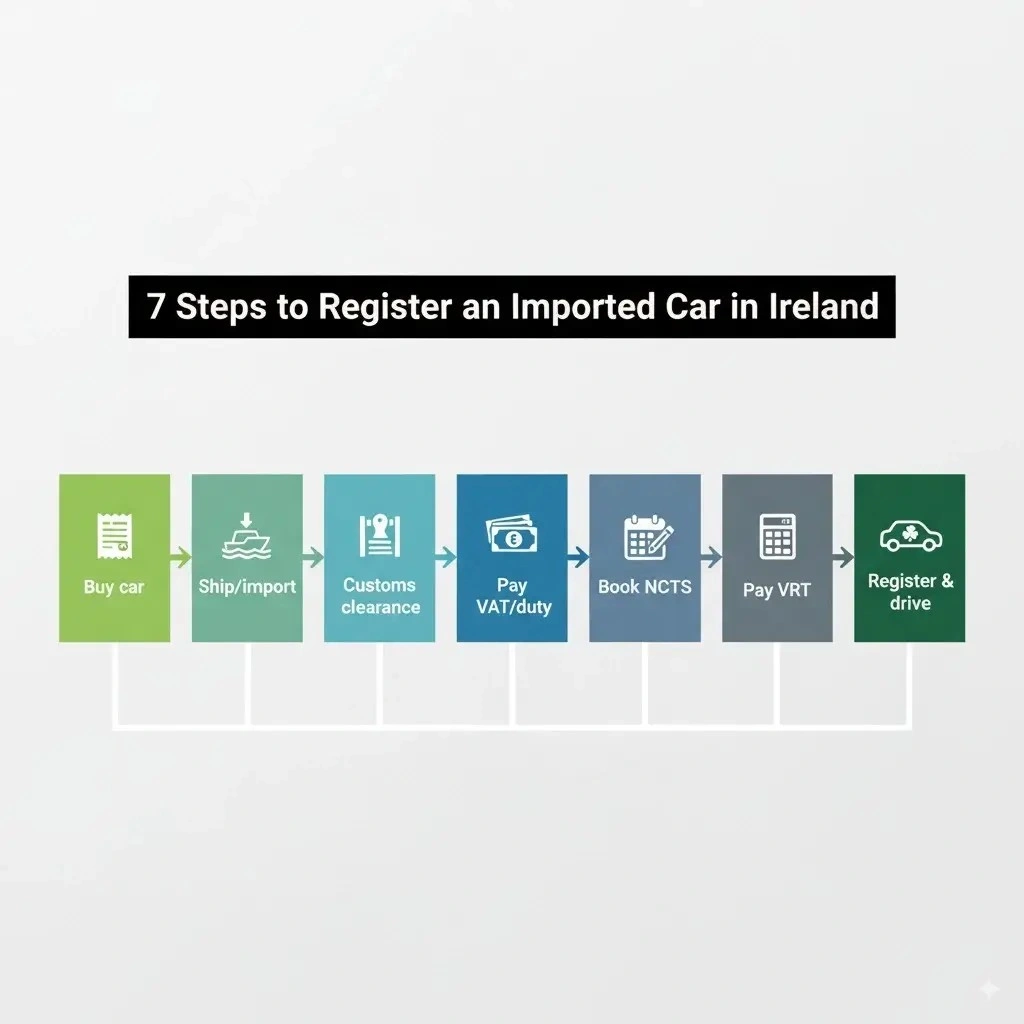
Here's where it all comes together. The three taxes apply in a specific sequence, and understanding this sequence is essential for working out your total cost:
- You buy the car abroad and arrange shipping to Ireland
- When the car arrives at the port, you (or your customs agent) submit a customs declaration
- Customs duty is calculated on the CIF value (purchase price + shipping + insurance)
- VAT is calculated on the CIF value plus customs duty
- You pay customs duty and VAT to get the car released from customs
- You book a VRT appointment with NCTS
- At the appointment, Revenue assesses the OMSP and calculates VRT
- You pay VRT and get your Irish registration
The key interaction is this: customs duty adds to the value that VAT is charged on. So the higher your shipping costs, the more VAT you pay. And VRT is completely independent of both - it's based on Revenue's OMSP, not your costs.
Total Landed Cost Examples for Different Origins
Let me give you three real-world examples so you can see how the numbers play out.
Example 1: Importing from the UK (Great Britain)
You buy a 2019 Volkswagen Golf 1.6 TDI from England. Purchase price: €12,000. Shipping and insurance: €600. Customs value: €12,600. Customs duty at 10%: €1,260. Value for VAT: €13,860. VAT at 23%: €3,187.80. Total import taxes: €4,447.80.
Now VRT. Revenue assesses the OMSP at €14,500 (because Irish used car prices are higher). The Golf emits about 110g/km CO2 (Band A3, 11%). VRT = €14,500 x 11% = €1,595. Plus a NOx levy of around €600. Total VRT: €2,195.
Total landed cost: €12,000 (purchase) + €600 (shipping) + €4,447.80 (customs + VAT) + €2,195 (VRT) = €19,242.80.
That's €7,242.80 in taxes on a €12,000 car.
Example 2: Importing from an EU country (Germany)
You buy a 2020 BMW 3 Series from Germany. Purchase price: €18,000. Transport: €400. No customs duty (EU single market). No import VAT (VAT already handled within EU). You just need to pay VRT.
Revenue assesses OMSP at €20,000. CO2 around 129g/km (Band B1, 15%). VRT = €20,000 x 15% = €3,000. NOx levy: roughly €400. Total VRT: €3,400.
Total landed cost: €18,000 + €400 + €3,400 = €21,800.
Compare that to buying the same car from an Irish dealer, where you'd probably pay €24,000 to €26,000. The saving is real.
Example 3: Importing from Japan (non-EU)
You import a 2018 Toyota Prius from Japan. Purchase price: €8,000. Shipping and insurance: €1,500. Customs value: €9,500. Customs duty at 10%: €950. Value for VAT: €10,450. VAT at 23%: €2,403.50. Import taxes: €3,353.50.
Revenue assesses OMSP at €11,000. The Prius is a hybrid with low CO2 (around 70g/km, Band A1, 7%). VRT = €11,000 x 7% = €770. NOx levy is minimal on a hybrid: maybe €100. Total VRT: €870.
Total landed cost: €8,000 + €1,500 + €3,353.50 + €870 = €13,723.50.
Strategies to Minimise Your Tax Bill Legally
I'm not going to suggest anything dodgy. Revenue has seen every trick in the book, and the penalties for underdeclaring are severe. But there are perfectly legal ways to reduce what you pay.
Buy from the EU when you can
This is the biggest one. Importing from an EU country means zero customs duty and no import VAT complications. You only pay VRT. The German and French used car markets are well-developed, prices are competitive, and the selection of left-hand drive cars is obviously much better. If you don't mind driving a left-hooker, this is your cheapest option.
Choose low-CO2 vehicles
The VRT rate is directly tied to CO2 emissions. A hybrid or electric car will pay a fraction of what a diesel SUV pays in VRT. A Toyota Corolla Hybrid (Band A2, 9%) costs a lot less in VRT than a BMW X5 diesel (Band F, 23%). If you're importing, factor the CO2 band into your buying decision, not just the purchase price.
Get accurate shipping quotes
Since VAT is calculated on the customs value including shipping, overpaying for transport costs you double. Get competitive quotes for shipping and use Ro-Ro (roll-on, roll-off) rather than container shipping if possible. It's cheaper and the car drives on and off the ship.
Use Revenue's VRT enquiry before you buy
You can submit the car's details to Revenue through the ROS VRT enquiry system and get an OMSP estimate before you commit to buying. It's not binding - Revenue can change the OMSP at the actual appointment - but it gives you a ballpark figure. If the estimate comes back way higher than you expected, you can walk away from the deal.
Check for VRT reliefs
There are various VRT reliefs and exemptions available. If you're transferring your residence to Ireland (moving home after living abroad for at least 6 months), you may qualify for a VRT relief under the Transfer of Residence scheme. Disabled drivers and passengers can get significant VRT reductions. Electric vehicles sometimes qualify for VRT relief, although the rules change frequently. Check Revenue's relief pages for the current situation.
Consider the age of the car
Older cars have lower OMSPs, which means less VRT. But there's a catch. Revenue applies an age-related depreciation formula to the OMSP for cars over a certain age. However, cars over 30 years old can be declared historic vehicles and may qualify for a flat VRT rate of €200. Worth knowing if you're into classic cars.
The Paperwork You'll Need
I won't lie to you - the paperwork for importing a car is substantial. Here's what you need to have ready:
- Proof of purchase (invoice or sales contract, showing the price and both parties' details)
- Foreign registration document (V5C logbook for UK cars, Fahrzeugschein for German cars, etc.)
- Certificate of Conformity (CoC) if available - this makes VRT assessment much smoother
- Proof of customs clearance (the SAD document or C88 form)
- Proof of VAT payment (customs receipt)
- Shipping documents (bill of lading or CMR note)
- Passport or photo ID
- Proof of address in Ireland
If you're missing any of these, the NCTS appointment can be delayed or refused. I've heard stories of people having to make multiple trips because they forgot the original V5C or didn't have the right customs stamp. Get everything in order before you book.
Motor Tax and NCT: What Happens After VRT
Once you've paid VRT and got your Irish registration, there are two more things you need to sort out. First, motor tax. In Ireland, you pay motor tax annually (or quarterly or half-yearly if you prefer). The rate depends on the CO2 emissions of your car. For a Band A1 car (under 80g/km), it's €170 a year. For a Band F car (over 191g/km), it's €2,350 a year. That's a big difference that most people forget to budget for.
Second, the NCT. If your imported car is four years old or more, it needs an NCT test within a certain timeframe after registration. The test checks roadworthiness, brakes, lights, suspension, tyres, and emissions. If it fails, you have to fix the issues and get it retested within 30 days. Some imports, especially older ones from non-EU countries, can struggle with the NCT emissions test because their emissions systems are calibrated for different fuel standards.
One thing I've seen catch people out: modifying the car before registration. If you lower the suspension, fit aftermarket wheels, or change the exhaust before the NCTS appointment, you could cause problems. The inspector at the VRT appointment checks that the car matches its documentation. Modifications can raise questions and delay the process. Better to register it first, then modify it afterwards.
Common Mistakes That Cost People Money
I've seen these mistakes over and over in online forums and车主 groups. Learn from them.
Not budgeting for the total landed cost. People look at a car priced at €8,000 in Japan and think they're getting a steal. By the time it's on Irish plates, they've paid €13,000 or more. That's still a good deal for the right car, but you need to know the full number before you commit.
Ignoring the OMSP risk. You might find a bargain on a UK dealer's forecourt because the car has high mileage or minor damage. But Revenue's OMSP is based on average market conditions. If you paid below market value, you're not getting a VRT discount - you're paying VRT on a higher value than your purchase price.
Missing the 30-day registration window. Revenue requires you to register the car within 30 days of it entering the State. If you miss this deadline, you face penalties and potential prosecution. Book your NCTS appointment as soon as the car arrives, not when you get around to it.
Using a mate's advice instead of official sources. I see people on forums saying "ah sure, I imported a car last year and I didn't pay any customs duty." Either they imported from the EU, got lucky with enforcement, or they're not telling the full story. Check Revenue.ie directly, not Facebook groups.
If you're feeling overwhelmed by all this, that's normal. The Irish car import system has more layers than an onion. But thousands of people navigate it successfully every year, and you can too. The trick is taking it step by step: understand the taxes, get your paperwork right, use the right professionals where needed, and don't cut corners. A rushed import is an expensive import.
Frequently Asked Questions
Do I need a customs agent, or can I do it myself?
You can do the customs declaration yourself through Revenue's online system (AES - Automated Entry Processing). But honestly, most people use a customs agent. The forms are fiddly, the HS codes need to be right, and one mistake can hold your car at the port for days. A good customs agent charges maybe €100 to €200 and saves you a lot of hassle.
Can I drive an imported car on UK plates while I sort the paperwork?
No. Once the car is in Ireland, it needs to be registered with Revenue and get Irish plates within 30 days. Driving on foreign plates after that point is an offence. You can get temporary transit permits in some cases, but they're limited.
What if the car fails the NCTS inspection?
The NCTS inspection at VRT registration checks the vehicle's identity and documents, not its roadworthiness (that's the NCT, which is separate). If there's a discrepancy with the VIN or the documentation doesn't match, you'll need to sort it out before reregistration. Major modifications can also cause issues - especially if the car has been modified from factory spec.
Is it cheaper to import or buy in Ireland?
There's no simple answer. For popular mainstream cars like Volkswagen Golfs and Ford Focuses, the price difference after all taxes is often small, and buying locally is less hassle. But for premium cars, performance cars, or specific models that are rare in Ireland, importing can save thousands. The key is doing the full landed cost calculation before you decide.
Does the VRT calculator on Revenue's website give an accurate figure?
It gives an estimate based on the information you provide. The final VRT is calculated at the NCTS appointment when Revenue physically inspects the car and confirms its OMSP and emissions. The calculator is useful for budgeting, but don't treat its figure as guaranteed.
Importing a car to Ireland isn't as simple as buying one locally. But for the right car - especially a premium model, a performance car, or something you simply can't find in Ireland - the savings and the satisfaction of getting exactly what you want make it worth the effort. The key is going in with your eyes open. Know the three taxes, understand how they stack, budget for the full landed cost, and don't rush the paperwork. Do that, and you'll be driving your imported car on Irish plates with a smile instead of a headache.