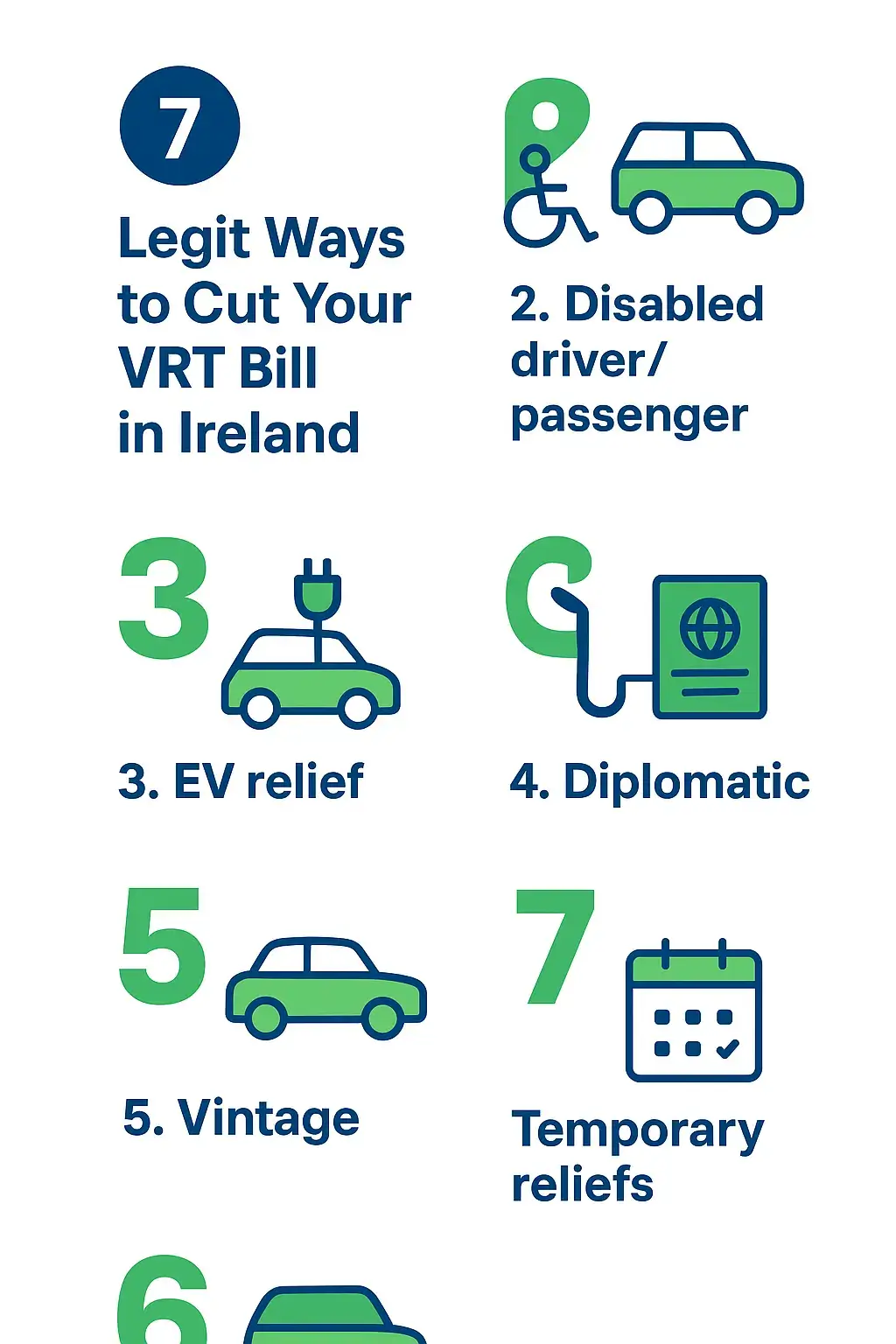
There's a moment every Irish emigrant knows well. You're standing in a carpark somewhere in Australia or Canada or London, looking at your car, and thinking: how much is this going to cost me to bring home? You've heard the horror stories. Someone's cousin paid five grand in VRT. Someone else's friend sold their car because the tax was too high.
But here's what I've learned from helping people through this process. Most of those horror stories come from people who didn't know about the reliefs and exemptions available to them. The rules exist, they're on Revenue's website, and they can save you a serious amount of money. When you book your VRT inspection, you will visit an NCTS (National Car Testing Service) centre, where they verify your vehicle's details before registration.
I've broken down every major VRT relief and exemption in Ireland, explained how they work, and told you what you need to do to actually get them. Some of these can save you thousands. A couple of them can save you everything.
The difference between an exemption and a relief
Quick clarification before we dive in. An exemption means you pay zero VRT. A relief means you pay less. Both require an application, both come with conditions, but the stakes are obviously higher with exemptions because you're talking about the full tax being written off.
Revenue uses these terms precisely, and you should too. If you tell Revenue you're applying for an exemption when you really want a relief, you might end up on the wrong application form, which wastes everyone's time.
Transfer of Residence relief: for people coming home
Transfer of Residence, or ToR, is the relief that saves returning Irish emigrants from paying VRT on the car they already own. It's a full exemption, which means you pay nothing.
Who gets it
You need to have lived outside Ireland for at least 12 continuous months. You need to have owned and used the car for at least 6 months before you move back. And you need to bring the car into Ireland within 12 months of returning.
The 12-month residence rule trips people up more than anything. I've seen applications rejected because someone was 18 days short. Revenue counts every day. If you've been abroad for 11 months and 2 weeks, wait another two weeks before you move back. It makes a difference.
The 12-month holding rule
Once you register the car in Ireland, you can't sell it for 12 months. If you do, you'll have to repay the full VRT. This catches people who move back, register their car, then decide they want something different a few months later. Tough luck. Revenue wants to see that the relief was genuinely needed, not just a way to avoid tax on a car you planned to flip.
What you need to provide
Revenue wants proof of everything. Your foreign address, your employment, your ownership of the vehicle, your use of the vehicle. Bank statements, utility bills, employment contracts, the vehicle's foreign registration document. Keep copies of everything. Certified copies are usually required, so factor in the cost and time of getting documents certified.
EV relief: up to 5,000 off
The government wants you driving electric, and they're willing to put money behind that goal. If you buy or import an electric car, you can get up to 5,000 off your VRT.
How the math works
Cars with an OMSP of up to 40,000 get the full 5,000 relief. Between 40,000 and 50,000, the relief tapers down gradually. Over 50,000, there's no relief at all. This is deliberate - the government wants to encourage more affordable EVs, not subsidise luxury cars.
The relief is applied automatically during registration, so you don't need to submit a separate application. But check your VRT assessment carefully. Mistakes happen, and you don't want to miss out on a relief you're entitled to because of a data entry error.
Electric motorcycles
Series-production electric motorcycles and e-mopeds are completely exempt from VRT right now. The exemption runs until 31 December 2025. After that, it could go either way. If you've been thinking about an electric bike, don't wait.
Hybrids get less
Hybrids qualify for some relief, but not as much as full EVs. The amount depends on CO2 emissions and electric range. A plug-in hybrid with 50km of electric range gets more relief than a mild hybrid that barely runs on battery. If you're choosing between a full EV and a hybrid, the VRT relief difference might help you decide.
Disabled Drivers and Disabled Passengers Scheme
This is one of the most generous schemes in the VRT system, and it's also one of the least understood. It offers relief on both VRT and VAT for adapted vehicles used by people with qualifying disabilities.
The medical side
You need a Primary Medical Certificate from the HSE. This is a formal assessment based on specific criteria. The qualifying conditions include being without the use of your legs, being fully deaf, or having a condition that requires you to use a wheelchair. There are other qualifying conditions too, so check the full list on Revenue.ie.
The assessment is done by HSE doctors, not your GP. It can take a few weeks to get an appointment and a decision, so factor that into your timeline.
The vehicle side
The car needs to be adapted for your disability. The amount of relief depends on how much adaptation is needed. Category A covers vehicles with major adaptations like wheelchair access. Category B covers vehicles with less significant modifications. The relief amounts are different for each category.
The retention side
You generally need to keep the vehicle for at least six years. If you sell it before that, you'll have to repay some or all of the relief. There are exceptions for things like accidents or theft, but plan on keeping the car for the long term.
Vintage and classic cars
If your car is 30 years old or older, it qualifies for the vintage vehicle rate. This is a flat VRT charge, historically around 200, which is drastically less than what you'd pay on a normal car of similar value.
But here's the catch. The vehicle needs to be in original or restored-to-original condition. Modified cars might not qualify. And Revenue can change the classification rules, so check before you buy.
A friend of mine bought a 1992 Mercedes SL, banking on the 200 VRT rate. Revenue classified it differently because it was a later model year than he thought. He ended up paying significantly more. Always check the exact date of first registration, not the model year.
Agricultural vehicles
Tractors, combine harvesters, and other agricultural machinery can qualify for VRT exemptions. The vehicle needs to be used exclusively for agricultural purposes, and you'll need to prove that.
This isn't a loophole you can exploit to save VRT on a Land Rover. Revenue is well aware of the rules. If you register a vehicle as agricultural and use it for the school run, they'll catch up with you eventually.
Charitable exemptions
Registered charities can claim VRT exemptions on vehicles used exclusively for charitable purposes. This covers things like ambulances, mobile clinics, and vehicles used to deliver charitable services.
The charity needs to be registered with Revenue, and the vehicle's use needs to be genuinely charitable. A car used partly for charity work and partly for personal errands won't qualify.
Diplomatic exemptions
Diplomats and staff of certain international organisations can get full VRT exemptions. This is governed by international agreements, and the process involves both Revenue and the Department of Foreign Affairs.
If this applies to you, you probably already know. But if you're working for an embassy or international body and aren't sure about your VRT situation, ask your organisation's admin team. They handle these things regularly.
How Revenue's application system works
You apply through Revenue's online services. For individuals, that's myAccount. For businesses and agents, it's ROS. Some reliefs need paper forms too, but the process starts online.
You'll need to select the right relief category, upload your documents, and wait for Revenue to process your application. Processing times vary. Some reliefs are approved in a few weeks. Others take months. Don't leave it until the last minute.
If your application is approved, you'll get a notification through myAccount or ROS. If it's rejected, you'll get a reason. You can appeal a rejection by writing to Revenue with additional evidence or an explanation of why you think the decision was wrong.
Navigating Revenue's myAccount system
If you've never used Revenue's myAccount before, here's what you need to know. It's the online portal where you manage your tax affairs, including VRT relief applications. You'll need to register for an account if you don't already have one. The registration process requires your PPS number and some personal details. Once complete, your vehicle receives an IRN (Irish Registration Number) and can be driven legally on Irish roads.
Once you're logged in, look for the VRT section. The menu structure changes sometimes when Revenue updates the system, but generally you'll find VRT options under the vehicles or motor tax section. You'll need to select the specific relief you're applying for and follow the prompts to upload your documents.
The system accepts PDF files and image files. Make sure your documents are clear and readable. A blurry scan of a utility bill won't do you any good. If you're uploading certified copies, make sure the certification is visible on the scan.
One tip: save your application reference number. Revenue will give you one when you submit. Write it down, take a screenshot, do whatever you need to do. If you need to follow up on your application, that reference number is the key to getting a quick response.
Real examples of successful applications
I've collected some examples that show how these reliefs work in practice. The names aren't real, but the scenarios are based on actual cases.
Emma's EV import. Emma imported a 2022 Hyundai Kona Electric from the UK. The OMSP was assessed at 32,000. Her standard VRT was 3,840, but the EV relief of 5,000 reduced it to zero. Her NOx levy was zero. Total VRT bill: 0. She paid nothing to register her EV, thanks to the combination of relief and zero emissions.
John's classic Mini. John bought a 1989 Mini Mayfair that he found in a barn in Wales. The car was first registered in August 1989, making it over 30 years old. He paid the 200 flat rate for Category C classification. If the same car had been assessed under normal VRT rules, it would have cost about 600 to 800 based on its value. The vintage rate saved him around 500.
Declan's agricultural tractor. Declan imported a used tractor from Germany for his farm in Meath. He applied for the agricultural vehicle exemption and provided proof of his farm registration, the vehicle's intended use, and his tax clearance certificate. The exemption was approved, and he paid zero VRT on a vehicle worth over 25,000.
Aoife's adapted vehicle. Aoife's daughter needs a wheelchair-accessible vehicle. They applied through the disabled drivers scheme and received a Primary Medical Certificate from the HSE. The adapted MPV cost 48,000, and the VRT relief covered over 10,000 of that. Aoife told me the process was slow but fair. The key was starting early, before they committed to buying the vehicle.
The appeals process step by step
If Revenue rejects your application, you have the right to appeal. Here's how it works.
First, write to Revenue within 30 days of receiving the rejection. Explain clearly why you think the decision was wrong. Reference the specific criteria you believe you meet. Include any new evidence that supports your case.
Revenue will review your appeal. This is handled by a different officer than the one who made the original decision, so you're getting a fresh look at your case. The review can take four to eight weeks.
If Revenue upholds the rejection, you can take the case to the Tax Appeals Commission. The Commission is independent of Revenue. You'll need to submit your case in writing, and there may be a hearing. The process can take several months, and there's a fee involved for some types of appeals.
My honest advice? Try to avoid needing to appeal. It's time-consuming and stressful. Get your application right the first time, with all the necessary documentation, and you'll save yourself a lot of hassle.
Common reasons applications fail
After helping several people through this process, I've noticed the same problems coming up again and again.
Timing issues. People apply too late, or they import the car before getting approval, or they miss the window for bringing the vehicle into Ireland. The deadlines are fixed. Revenue won't bend them.
Incomplete paperwork. This is the big one. You need certified copies of most documents. You need dates on everything. You need your name to match across all documents. A single discrepancy can stall the whole application.
Not meeting the criteria. Some people apply for reliefs they don't actually qualify for. They've heard ToR exists, so they apply, even though they've only been living abroad for six months. Read the criteria before you apply, not after.
Changes in policy. Budget announcements can change relief amounts and eligibility. If you're planning an application based on rules from six months ago, check again. Revenue.ie is updated regularly.
Practical advice for getting approved
Start early. I know I keep saying this, but it's the single most important piece of advice. Start the application process months before you need to register the vehicle.
Over-prepare your documents. If Revenue asks for three things, give them five. If they ask for certified copies, get them certified even if it costs a few euro. More evidence is always better than less.
Keep a paper trail. Every communication with Revenue should be documented. If you call them, note the date, time, and who you spoke to. If you submit documents online, save the confirmation.
Consider professional help. Customs agents and VRT consultants deal with Revenue daily. They know what works and what doesn't. Paying a few hundred euros for professional advice can save you thousands in VRT.
What changes are coming
VRT reliefs change with every budget. The EV relief has been adjusted multiple times. The electric motorcycle exemption has a hard end date of December 2025. Vintage car rates could change at any time.
The best way to stay informed is to check Revenue.ie regularly. Don't rely on forum posts or Facebook groups. People mean well, but they're often working with outdated information.
How reliefs interact with each other
A common question I get is whether you can stack multiple reliefs on the same vehicle. The short answer is no, generally. Most reliefs are designed to be exclusive. You can't claim ToR and EV relief on the same car because ToR gives you a full exemption, so there's nothing for the EV relief to reduce.
But there are some situations where you can benefit from more than one. For example, a vintage car that's also electric would qualify for both the vintage rate and the EV relief. In practice, there aren't many 30-year-old EVs on the market, but the possibility exists.
Another example is a vehicle that qualifies for both the disabled drivers scheme and a charitable exemption. In theory, you could choose whichever gives you the better outcome, but you can't claim both.
The lesson here is to pick the best relief for your situation and stick with it. Don't try to game the system by claiming multiple reliefs on the same vehicle. Revenue will catch it, and you'll end up with nothing.
How Revenue checks your application
Revenue doesn't just process your application in isolation. They cross-reference your information with other sources. Your travel history, your employment records, your tax returns, and the vehicle's international registration history are all fair game.
For ToR applications, Revenue can check exactly when you left Ireland and when you returned. If you claimed you were living abroad for 12 months but your passport shows you were back in Ireland for a wedding in the middle, they'll question whether you meet the continuous residence requirement.
For vehicle history, Revenue has access to international databases. They can see where and when the vehicle was registered, who owned it, and whether it's been imported before. If you claim you've owned a car for six months but the registration records show the previous owner only sold it to you two months ago, they'll know.
This isn't meant to scare you. It's just a reminder that the system is designed to catch inconsistencies. If you're honest and accurate, you have nothing to worry about. If you try to push the boundaries, you'll probably get caught.
Using our VRT calculator alongside reliefs
Our VRT calculator can help you understand what your VRT bill would be without any reliefs. That baseline number is important because it shows you exactly how much a relief could save you. When you see that your ToR relief saves you 3,500, or that the EV relief brings your bill down to zero, the numbers feel real.
The calculator can also help you compare different vehicles. If you're choosing between a diesel estate and a hybrid SUV, the VRT difference might be substantial, especially when you factor in the NOx levy and any applicable reliefs.
I always recommend using the calculator early in your car-buying process. Don't wait until you've found the perfect car and agreed on a price before you check the VRT. Check multiple options, factor in the reliefs you qualify for, and make an informed decision.
The importance of keeping records
Once your relief is approved, don't throw away your documents. Revenue can come back years later to verify that you still meet the conditions. If you've claimed ToR, they might ask for proof that you still own the vehicle after the 12-month holding period. If you've claimed the disabled drivers scheme, they might check that the vehicle is still adapted and still used by the qualifying person.
Keep a folder with all your original documents, certified copies, and correspondence with Revenue. Keep the receipts for any modifications or adaptations. Keep proof of insurance and NCT for the vehicle. Having this information readily available will save you stress and money if Revenue ever queries your application.
I keep everything in a digital folder and a physical folder. Scans of everything, backed up, plus the originals in a binder. It might seem like overkill, but when Revenue asks for something, you don't want to be scrambling to find it.
Final advice
VRT is expensive, but exemptions and reliefs can make it manageable. Whether you're moving home, going electric, or driving a classic, there's a good chance you can reduce your bill.
The key is to do your homework, prepare your documents, and apply early. Use our VRT calculator to understand what you'd pay without reliefs, then factor in whatever relief you qualify for. That way, you'll know your real costs before you commit to a purchase.