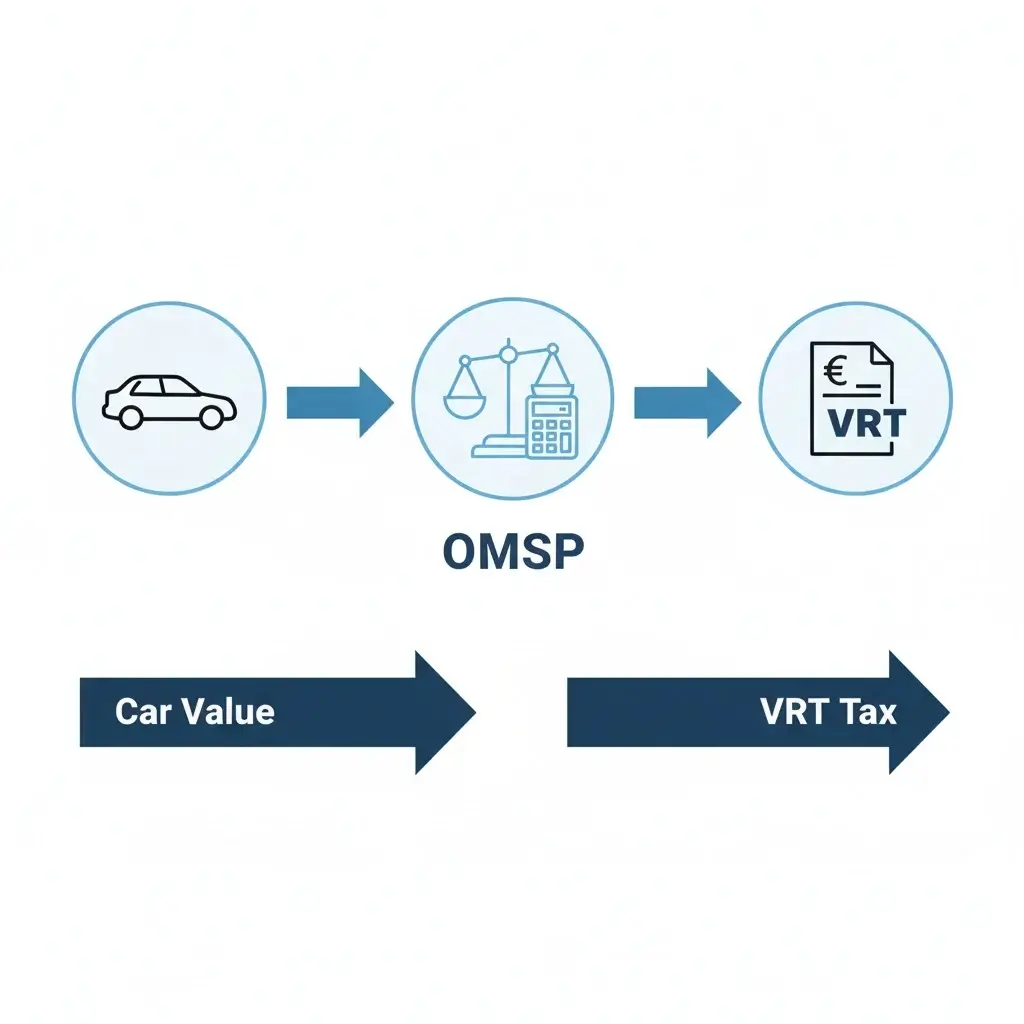
You buy a car in the UK for EUR 6,000. A 2014 Ford Focus, 80,000 miles, reasonable condition. You know VRT will be due, and you've budgeted for it. Then you get to the VRT office and Revenue tells you the car has an Open Market Selling Price of EUR 9,500. Your VRT is calculated on that figure, not what you actually paid. Suddenly your bill is a lot higher than you expected.
If this scenario sounds familiar, welcome to the world of OMSP. It's one of the most confusing and frustrating parts of importing a car to Ireland, and it catches people out all the time. I've lost count of how many people have told me they felt like Revenue was making up a number out of thin air. But the truth is, there's a method to it. Whether you agree with that method is another question.
In this guide, I'm going to explain exactly what OMSP is, how Revenue calculates it, what you can do if you think it's wrong, and how to get a rough idea of what your OMSP will be before you even buy the car.
What Is OMSP?
OMSP stands for Open Market Selling Price. It's Revenue's estimate of what your car would sell for on the open market in Ireland, assuming a sale between a willing buyer and a willing seller. It's not what you paid for the car in another country. It's not what the car is worth to you. It's what Revenue believes it would fetch if it were sitting on a forecourt in Dublin or Cork or Galway.
This distinction matters because VRT is calculated as a percentage of the OMSP. If Revenue says your car is worth EUR 10,000 and the VRT rate for its CO2 band is 19%, you're paying EUR 1,900 in VRT before you even get to the NOx levy or any other charges.
The OMSP is set when you present the car for VRT assessment. A Revenue officer inspects the vehicle, checks its details, and assigns an OMSP based on the data available to them. That OMSP is then used to calculate your VRT bill on the spot.
How Revenue Calculates OMSP
Revenue's valuation method is outlined in their VRT Manual, specifically Section 8 which covers valuation. The manual is available on the Revenue website, though it's not the easiest document to find or read. Let me break it down in plain English.
The Starting Point: Market Data
Revenue uses a combination of sources to determine OMSP. The primary source is market data from Irish car sales. They track what similar cars are actually selling for at dealers and through private sales across the country. This gives them a baseline for what each model is worth in the current market.
If you're thinking that sounds reasonable, you're right. The problem is that Revenue's data isn't always up to date. The market can shift quickly, and if Revenue is working with data that's a few months old, their OMSP might not reflect what's actually happening right now.
Revenue also uses depreciation tables. These are standardised schedules that show how a car's value decreases as it gets older. The tables are based on general market trends rather than specific vehicle data. They're a starting point, not a final answer.
The Factors Revenue Considers
When a Revenue officer assesses your car, they look at several specific factors:
- Make and model. A BMW 5 Series will always have a higher OMSP than a Ford Mondeo of the same age, because the market value is higher.
- Trim level. An SE model is worth less than an ST-Line or an M Sport. Revenue knows the difference and will adjust accordingly.
- Engine size and fuel type. Diesel vs petrol, 1.6 litre vs 2.0 litre. These affect market value and are factored into the OMSP.
- Mileage. This is one of the biggest factors. A car with 30,000 km will be valued notably higher than the same car with 150,000 km.
- Condition. Revenue officers are trained to assess condition. Scratches, dents, interior wear, and mechanical issues can all reduce the OMSP.
- Optional extras. Factory options like leather seats, sunroof, navigation, and upgraded wheels add value. Aftermarket modifications generally don't.
- Service history. A full service history can support a higher valuation, but the absence of one might not lower it as much as you'd hope.
Age-Related Depreciation and OMSP
Depreciation is one of the biggest factors in OMSP, and it's worth understanding how it works. Cars lose value fastest in their first few years, then the depreciation curve flattens out.
As a rough guide, a new car loses about 15 to 25% of its value in the first year alone. By year three, it might be worth 50 to 60% of its original price. By year five, you're looking at 40 to 50%. A ten-year-old car might be worth 20 to 30% of its original value, depending on the model and condition.
But here's where it gets tricky. Revenue's depreciation tables are general guidelines. They don't account for market quirks. For example, during the COVID-19 pandemic, used car prices went up notably because of supply shortages. Revenue's tables didn't immediately adjust, so some people got lower OMSP valuations than the market would have justified. Other times, the market drops and Revenue's tables are slow to follow.
I've seen this go both ways. A friend imported a 2018 Toyota Avensis in 2023 and got an OMSP of EUR 14,000. He checked online and found similar cars selling for EUR 11,000 to EUR 12,000. He appealed and got it reduced. The Revenue officer had been using older market data that didn't reflect the current market.
Why Your Invoice Doesn't Match OMSP
This is the thing that frustrates people most. You have an invoice showing you paid EUR 5,000 for a car in Japan or EUR 8,000 in the UK, and Revenue tells you the OMSP is EUR 11,000. How can that be right?
The answer is that the OMSP is not about what you paid. It's about what the car is worth in Ireland. And there are good reasons why the two might differ.
First, car prices vary between countries. A car that's common and cheap in the UK might be rare and expensive in Ireland. The opposite is also true. Some Japanese imports that are bargains in their home market are worth notably more here because of demand.
Second, your purchase price might not reflect the true market value. You might have got a good deal, or the car might have needed work that you've since done. The invoice shows what you paid, not what the car is worth.
Third, and this is the one that annoys people most, Revenue doesn't fully trust foreign invoices. They've seen cases where invoices were understated to reduce VRT, so they're naturally sceptical. Your invoice is evidence, but it's not conclusive evidence.
How Condition Affects OMSP
The condition of your car can make a real difference to its OMSP. Revenue officers assess condition as part of the VRT inspection, and a car in poor condition should get a lower valuation than a pristine example.
What counts as poor condition? Think notable body damage, worn interior, mechanical issues, warning lights on the dashboard, excessive rust, or accident damage. These things reduce the market value of a car, and Revenue should account for them.
But here's what I've noticed. Revenue officers are good at spotting obvious damage, but they might miss subtle issues. If your car has a mechanical problem that isn't visible, it might not be factored into the OMSP. That's why it's worth pointing out any issues you know about and providing evidence if you have it.
Photographs are your friend here. If your car has a dent in the door, a tear in the upholstery, or a cracked windscreen, take clear photos before the VRT appointment. Show them to the Revenue officer and make sure they're noted. If the officer doesn't adjust the OMSP on the spot, those photos will be useful evidence in an appeal.
I've also seen cases where people have had their OMSP reduced because the car needed major mechanical work. One person imported a car that needed a new clutch and had a knocking suspension. They got a mechanic's report, submitted it with their appeal, and the OMSP was reduced by EUR 1,500.
What to Do If You Think the OMSP Is Too High
If Revenue's OMSP assessment seems too high, you have options. You don't have to just accept it and pay up. Here's what I'd recommend.
Step 1: Check the Details
Before you do anything else, make sure Revenue has the right information about your car. I've seen cases where the wrong trim level was recorded, the wrong engine size was noted, or the mileage was entered incorrectly. A simple administrative error can inflate the OMSP by thousands of euros.
Check the VRT assessment form carefully. Does the make and model match? Is the trim level correct? Is the year of registration accurate? Even small errors can matter.
Step 2: Gather Comparable Sales
This is the most effective thing you can do. Find Irish market listings for cars that are the same make, model, trim, year, and similar mileage to yours. Don't use UK listings, don't use Northern Ireland listings unless they're from dealers who sell to ROI buyers. Irish market data is what Revenue respects.
You want at least three to five comparable listings. Screenshot them, note the date you found them, and include the URL. If the listings show prices below what Revenue assessed, you have the basis for an appeal.
Be honest with yourself about the comparables. If your car has 150,000 km and you're comparing it to cars with 80,000 km, Revenue will push back. Find listings that match your car's condition and mileage as closely as possible.
Step 3: Get a Professional Valuation
If the OMSP is notably higher than what comparable cars are selling for, consider getting a professional valuation. A qualified motor assessor or a dealer can provide a written valuation that you can submit as evidence. It costs money, but if the OMSP is over by EUR 2,000 or more, it's usually worth it.
Step 4: Appeal Formally
If you can't resolve the issue informally, submit a formal appeal. The appeals process is covered in detail in another guide, but the key points are: write clearly, include all your evidence, state what you believe the correct OMSP should be, and explain why based on the evidence you've provided.
How to Estimate OMSP Before You Import
You don't have to wait until you're at the VRT office to find out what the OMSP might be. There are ways to get a rough estimate before you buy.
First, check Irish car sales websites like DoneDeal, Carzone, and CarsIreland. Look for cars that match the one you're planning to import. The prices you see are retail prices from dealers and private sellers. Revenue's OMSP is based on retail values, so these are a good reference point.
Second, use Revenue's own VRT enquiry service. You can enter your car's details and get an estimate of the VRT, which includes an OMSP estimate. It's not binding, but it gives you a ballpark figure. The service is available through Revenue's ROS system or MyEnquiries.
Third, use our VRT calculator. It uses market data and Revenue's published depreciation schedules to give you an estimated OMSP. The estimate won't be exact, but it should be close enough to help you budget.
When you're estimating, be conservative. Assume the OMSP will be at the higher end of what you see in listings, not the lower end. Revenue's valuations tend to be based on retail prices from dealers, not the cheapest private sales. Budget for the higher figure, and if it comes in lower, you'll be pleasantly surprised.
Common OMSP Myths
There's a lot of bad advice floating around about OMSP. Let me clear up some of the most common myths.
Myth: OMSP is based on what you paid. It's not. Your invoice is one piece of evidence, but Revenue uses their own market data to set the OMSP. Don't assume your purchase price will match the OMSP.
Myth: A foreign invoice is all you need to lower the OMSP. It helps, but it's not enough on its own. You need Irish market comparables to show that your car's value is lower than what Revenue assessed.
Myth: OMSP is the same for all similar cars. It varies based on mileages, condition, trim level, and options. Two cars of the same model and year can have very different OMSPs.
Myth: You can't appeal the OMSP after you've paid. You can. If you successfully appeal and the OMSP is reduced, Revenue will refund the overpaid VRT. You don't lose your right to appeal by paying the initial assessment.
Myth: The Revenue officer's decision is final. It's not. The initial assessment is just the start. You can request an internal review, and if that doesn't work, you can take the case to the Tax Appeals Commission.
What Happens When You Get to the VRT Office
Knowing what to expect at the VRT appointment can help you prepare. The process goes something like this:
You arrive at the VRT office with your car, your documents (proof of origin, invoice, CoC, customs clearance, etc.), and your payment method. A Revenue officer inspects the vehicle. They check the VIN, the mileage, the condition, and the general specification. They take photos for their records.
The officer then consults their valuation system. They enter the car's details, and the system generates an OMSP based on the factors I described earlier. The officer has some discretion to adjust for condition and mileage, but most of the calculation is automated.
Once the OMSP is set, the system calculates the VRT based on the CO2 emissions band, applies any reliefs or adjustments, and adds the NOx levy if applicable. The officer shows you the breakdown and tells you what you owe.
At this point, you can ask questions. If the OMSP seems high, you can say so. The officer might be able to explain how they arrived at the figure. They might even adjust it if you can point to something specific. But don't expect a big reduction on the spot. The real negotiation happens through the formal appeals process.
Tax Appeals Commission and OMSP Disputes
If you've exhausted the internal review process and you still believe the OMSP is wrong, you can take your case to the Tax Appeals Commission (TAC). The TAC is independent of Revenue, and their decisions are binding on both parties.
The TAC process is more formal than an internal review. You'll need to submit a Notice of Appeal within the specified timeframe, usually 30 days from the date of Revenue's decision on your internal review. The TAC will then schedule a hearing where you can present your case.
I won't pretend the TAC process is easy. It takes time, and you might need professional representation. But for large OMSP disputes where thousands of euros are at stake, it can be worth it. The TAC has a good track record of making fair decisions based on the evidence rather than just deferring to Revenue.
Final Thoughts on OMSP
OMSP is one of those things that seems unfair until you understand how it works. Once you know that Revenue uses market data, depreciation tables, and condition assessments to arrive at their figure, it becomes less mysterious. You might not agree with their number, but at least you know where it came from.
The practical takeaway is this. Before you import a car, do your homework. Check what similar cars are selling for in Ireland. Use our OMSP estimator to get a rough figure. Budget for the higher end of the range. And if Revenue's assessment seems too high, don't just accept it. Gather your evidence, make your case, and appeal if necessary.
The system isn't perfect, but it's the system we have. Understanding it is the first step to making it work for you rather than against you.
Putting It All Together: Your OMSP Action Plan
Let me give you a simple checklist to follow if you're importing a car and want to avoid OMSP surprises.
Before you buy: Check Irish market prices for the same make, model, year, and trim you're looking at. Get a sense of what similar cars are selling for. Use our OMSP estimator to get a ballpark figure. Budget 10 to 15% above that estimate to be safe.
At the VRT appointment: Inspect the VRT assessment form carefully. Check every detail make, model, year, engine size, fuel type, trim level, mileage. If anything is wrong, point it out before you pay. Take your own photos of the car's condition before you arrive, in case you need them later.
If the OMSP seems high: Don't panic and don't just accept it. Ask the Revenue officer to explain how they arrived at the figure. If their explanation doesn't satisfy you, pay the assessed VRT to get your car registered (you need it on the road), and start the appeals process as soon as you can.
During the appeal: Gather your evidence. The most powerful evidence is comparable Irish market listings showing lower prices. Your purchase invoice helps but isn't enough on its own. Photos, service history, and independent valuations all strengthen your case.
Follow these steps and you'll be in a much better position to deal with whatever OMSP Revenue assigns to your car. You might not always get the result you want, but at least you'll know you did everything you could.
OMSP and Different Vehicle Types
The OMSP calculation isn't the same for every type of vehicle. Revenue uses different valuation approaches depending on whether the car is a standard passenger vehicle, a commercial vehicle, a motorcycle, or something more unusual like an imported classic or a grey import from Japan.
For standard passenger cars (Category A), the OMSP is based on Irish market data and depreciation tables. For commercial vehicles (Category B), the valuation tends to be simpler because there are fewer variables. For motorcycles, Revenue uses a specialised valuation system that reflects the different market dynamics.
If you're importing something unusual, like a grey import from Japan or a US-spec car, the OMSP can be harder to predict. Revenue has less market data for these vehicles, and the valuation may involve more judgment from the assessing officer. In these cases, getting a professional valuation before you import is highly recommended.