You've found it. A 2020 Volkswagen Golf on a UK site for what looks like a steal at EUR 12,500. You start doing the maths. Add the ferry, maybe a night in Holyhead, and you're still ahead of anything on DoneDeal. Then someone mentions VRT and suddenly you're not so sure. How much? How do you even pay it? Will Revenue just make up a number?
I've been there too. And honestly, the way people talk about VRT you'd think it was some kind of tax invented to punish anyone who dares buy a car abroad. But it's not that bad once you understand how it works.
This guide covers everything I wish someone had told me before I imported my first car. What VRT actually is, who pays it, how Revenue calculates it, what happens at your appointment, the myths people keep repeating, and real examples with actual euro figures. No jargon. No fluff. Just the stuff you need to know.
What is VRT? Let's Start With the Basics
VRT stands for Vehicle Registration Tax. It's a tax you pay when a vehicle is registered in Ireland for the first time. Once complete, your vehicle receives an IRN (Irish Registration Number) and can be driven legally on Irish roads. That includes brand new cars bought from an Irish dealership and used cars imported from abroad. If the car hasn't got Irish plates yet, VRT applies.
Revenue.ie is the body that collects it. You can find the official line on their VRT guide, but I'll save you the headache of reading through bureaucratic language. You bring a car into Ireland, you pay the tax. Simple enough.
What trips people up is the amount. VRT isn't a flat fee. It changes based on the car's value, its emissions, and a few other bits. For some cars it's a few hundred euro. For others, you're looking at five figures.
I've seen people walk into their VRT appointment thinking they owe EUR 2,000 and walk out with a bill for EUR 6,000. That's the kind of surprise that ruins your whole month. So let's make sure that doesn't happen to you.
Why Does Ireland Have VRT in the First Place?
People ask me this all the time. Why can't you just buy a car wherever you want and bring it home without being taxed again? It feels unfair, especially when you see what cars cost in the UK compared to here.
There are two main reasons VRT exists.
First, it generates serious revenue. VRT brought in over EUR 1 billion for the Irish government in 2023 alone. That's not pocket change. It funds roads, public transport, and all the other transport-related stuff the government spends on.
Second, and this is the one people don't talk about enough, it's designed to push you toward cleaner cars. The VRT system is heavily weighted by CO2 emissions. A diesel SUV that pumps out 180 g/km will cost you a fortune in VRT. An electric car? You'll pay a fraction of that. The government wants you to make the greener choice, and VRT is the stick they use to steer you there.
Whether you agree with it or not, that's how the system works. If you're importing a high-emission car, expect to feel the pain in your wallet.
So Who Actually Has to Pay VRT?
Short answer: pretty much anyone who registers a car in Ireland for the first time.
That includes:
- Private importers like you and me bringing in a car from Northern Ireland, Britain, or anywhere else
- Car dealers who import stock from abroad to sell on their forecourts
- People who buy new cars from Irish dealerships (though dealers usually handle this for you)
- Anyone inheriting or receiving a car from overseas as a gift
The only people who sidestep VRT are those buying a car that's already registered in Ireland. If it has Irish plates, VRT was already paid by someone else. You're off the hook.
There are also some exemptions, which I'll get to later. But for the average person importing a car, expect to pay.
How VRT Is Calculated: The Three Things That Matter
This is the bit everyone wants to know. How does Revenue decide what you owe?
Your VRT bill comes down to three main factors. Understanding these will save you from nasty surprises.
1. The Open Market Selling Price (OMSP)
This is the number that causes the most confusion. OMSP is Revenue's estimate of what your car would sell for on the open market in Ireland. It includes VAT and any other taxes.
Here's the thing that catches people out: the OMSP is not what you paid for the car. You could buy a car in Japan for EUR 8,000, but if similar cars sell for EUR 15,000 in Ireland, Revenue will base your VRT on the EUR 15,000 figure. You don't get credit for finding a bargain.
Revenue works out the OMSP by looking at what comparable vehicles are selling for in Ireland. They use data from dealerships, auctions, and online listings. If your car is rare or unusual, they might ask for more details to get the valuation right.
Can you challenge the OMSP? Yes, but it's not easy. You'd need to provide evidence that the valuation is wrong. I know people who've tried and mostly they ended up paying the original amount.
2. CO2 Emissions Band
This is where the environmental angle kicks in. Every car falls into a VRT band based on its CO2 emissions. The bands run from A1 (lowest emissions) to G (highest).
The percentage of OMSP you pay as VRT depends on your band. Here are the current rates as of 2026:
| Band | CO2 (g/km) | VRT Rate (% of OMSP) |
|---|---|---|
| A1 | 0-50 | 7% |
| A2 | 51-80 | 9% |
| A3 | 81-100 | 11% |
| A4 | 101-110 | 12% |
| B1 | 111-120 | 13% |
| B2 | 121-130 | 14% |
| C | 131-140 | 17% |
| D | 141-155 | 21% |
| E | 156-170 | 26% |
| F | 171-190 | 31% |
| G | 191+ | 36% |
See the difference? An electric car in band A1 pays 7%. A gas guzzler in band G pays 36%. On a car valued at EUR 20,000, that's EUR 1,400 versus EUR 7,200. Same car value, wildly different tax bill, all because of what comes out of the exhaust.
3. The NOx Levy
On top of the regular VRT, there's an extra charge for nitrogen oxide (NOx) emissions. This was introduced in 2020 and it mainly hits diesel cars, which tend to produce more NOx than petrol equivalents.
The NOx levy is calculated per mg/km of NOx emissions. The rate changes depending on the level:
- Up to 60 mg/km: EUR 5 per mg/km
- 61 to 80 mg/km: EUR 15 per mg/km for this portion
- 81 mg/km and above: EUR 25 per mg/km for this portion
There's also a maximum cap. As of 2026, the maximum NOx levy is EUR 4,850. So even if you import the dirtiest diesel known to man, you won't pay more than that in NOx charges alone.
I'll give you a real example. A 2017 BMW 520d might have NOx emissions around 80 mg/km. That works out to (60 x 5) + (20 x 15) = 300 + 300 = EUR 600 in NOx levy. On top of whatever VRT you're already paying for the CO2 band and OMSP. It adds up.
The VRT Appointment: What Actually Happens
You've done your research. You've bought the car. You've shipped it or driven it to Ireland. Now you need to book the VRT appointment. Here's how it works.
Booking the Appointment
You book your VRT inspection through the NCTS (National Car Testing Service) website. They handle VRT appointments on behalf of Revenue. You need to do this within 7 days of the car arriving in Ireland. That's a legal requirement, not a suggestion.
Appointments are available at NCTS centres around the country. Dublin, Cork, Galway, Limerick, and most major towns have them. You can usually get an appointment within a week or two, though summer months can be busier.
What to Bring
Don't show up without the right paperwork. You'll need:
- Your passport or driving licence (photo ID)
- Proof of address (a utility bill or bank statement)
- The vehicle's registration document (V5C for UK cars, equivalent for others)
- Proof of purchase (receipt, invoice, or bill of sale)
- The vehicle's certificate of conformity (or equivalent documentation)
- Customs clearance documents if importing from outside the EU
- NOVA declaration confirmation (for UK imports since Brexit)
Missing documents is the most common reason appointments get rejected. Double check everything the night before.
What Happens at the Inspection
The NCTS inspector will check the vehicle against the documents you provided. They look at the VIN (chassis number), mileage, and general condition. They also take photos for Revenue's records.
If the car has damage or modifications that affect its value, the inspector will note these. That can work in your favour if it lowers the OMSP.
After the inspection, you get a VRT assessment. This tells you exactly what you owe. You then have 30 days to pay it. You can pay online through Revenue's MyAccount service, at a Revenue office, or through some payment kiosks at NCTS centres.
After You Pay
Once the VRT is paid, you get your Certificate of Registration (RF1 form or similar). Take that to your local motor tax office with proof of insurance and you can get your Irish registration plates made up. That's it. You're legal.
One thing to note: the whole process from appointment to plates can take a few weeks. Don't plan any road trips for the day after your appointment.
Common VRT Myths People Still Believe
I've heard so many myths about VRT over the years. Some of them are harmless. Others could cost you money if you believe them. Let me bust a few.
Myth 1: "VRT is the same as motor tax"
I hear this one constantly. It's wrong. VRT is a one-off tax you pay when you register the car. Motor tax is what you pay every year to drive it on public roads. They're completely separate. You pay VRT once. You pay motor tax annually. Two different bills, two different purposes.
Myth 2: "VRT is just VAT by another name"
Also wrong. VAT is a sales tax that applies to most goods and services. VRT is a specific tax on vehicle registration. You actually pay VAT on the purchase price and then VRT on top. They're not the same thing and you don't get one waived if you've paid the other.
Myth 3: "If I buy a cheap car, the OMSP will be based on what I paid"
I wish this were true, but it's not. Revenue uses market value, not your purchase price. Buying a car for a bargain price in the UK doesn't mean you'll pay less VRT. Revenue will look at what that car sells for in Ireland and use that number.
Myth 4: "Electric cars are completely exempt from VRT"
Not entirely. Electric vehicles do get notable relief, but it's not a full exemption. EVs get a VRT relief of up to certain limits, but if the car's value is high enough, you'll still pay some VRT. It's just a lot less than a petrol or diesel equivalent.
Myth 5: "You can avoid VRT by registering in Northern Ireland"
This one comes up a lot. If you live in the Republic and drive a car with NI plates, Revenue will eventually catch up with you. There are rules about where a car must be registered based on where you live. Trying to dodge VRT by using foreign plates can lead to fines, seizure, and a backdated VRT bill. Not worth it.
Real Examples: What People Actually Pay
Let's look at some real-world examples so you can see how the numbers work out.
Example 1: 2022 Tesla Model 3 (Electric)
You import a 2022 Tesla Model 3 from the UK. It has 30,000 km on the clock. OMSP is assessed at EUR 38,000. CO2 is 0 g/km, so it's in band A1 at 7%.
VRT: EUR 38,000 x 7% = EUR 2,660
NOx levy: EUR 0 (electric cars produce no NOx)
Total VRT: EUR 2,660
That's not bad for a EUR 38,000 car. The EV relief makes a real difference here.
Example 2: 2019 Volkswagen Golf 1.6 TDI (Diesel)
A 2019 Golf with 60,000 km. OMSP around EUR 18,500. CO2 is 115 g/km, putting it in band B1 at 13%. NOx emissions around 75 mg/km.
VRT: EUR 18,500 x 13% = EUR 2,405
NOx levy: (60 x 5) + (15 x 15) = 300 + 225 = EUR 525
Total VRT: EUR 2,930
Almost EUR 3,000 on a car worth EUR 18,500. That stings, but it's typical for a diesel Golf.
Example 3: 2016 BMW X5 xDrive30d (High Emissions)
This is where it gets scary. OMSP around EUR 32,000. CO2 is 180 g/km, band F at 31%. NOx emissions around 90 mg/km.
VRT: EUR 32,000 x 31% = EUR 9,920
NOx levy: (60 x 5) + (20 x 15) + (10 x 25) = 300 + 300 + 250 = EUR 850
Total VRT: EUR 10,770
Over EUR 10,000 in tax on a car you already paid for. That's why you don't see many older diesel SUVs on Irish roads compared to the UK.
Tips for Reducing Your VRT Bill
You can't avoid VRT, but you can make smart choices that keep the bill down.
Pick a car with low CO2. This is the biggest lever you have. A car in band A1 pays 7%. A car in band G pays 36%. The difference on a EUR 20,000 car is over EUR 5,000. Do your homework on emissions before you buy.
Consider an electric or hybrid. The VRT relief on EVs is generous. Even plug-in hybrids get lower rates than pure petrol or diesel. If you can make electric work for your lifestyle, the VRT savings alone can be thousands.
Don't overspend on purchase price. Remember, the OMSP is based on Irish market values. Buying a car at the top of its market value range means a higher OMSP and more VRT. Look for cars that represent good value in the Irish market.
Declare damage honestly. If the car has dents, scratches, or mechanical issues, the OMSP should reflect that. Don't lie, but don't hide things either. A damaged car has a lower OMSP.
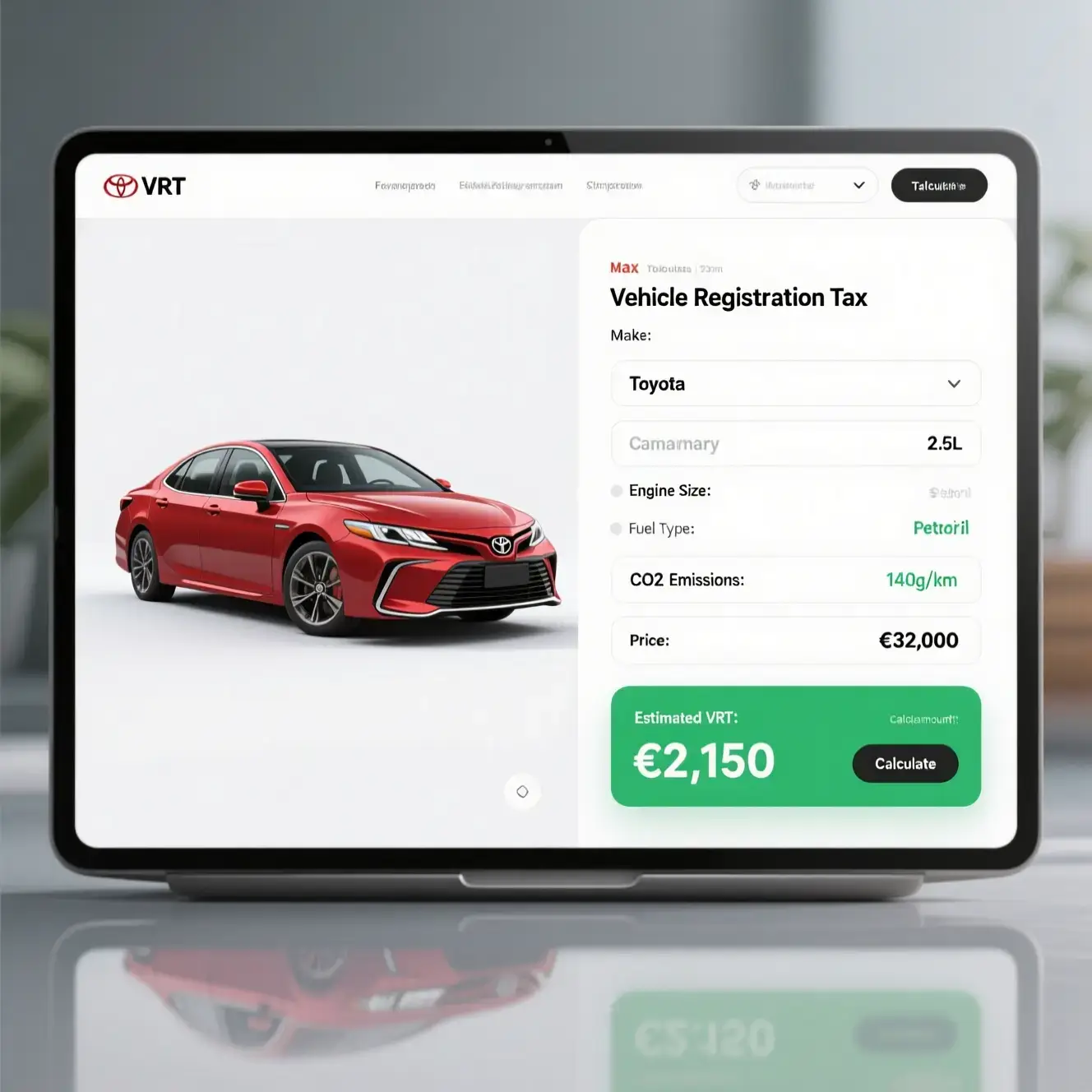
Use a VRT calculator before you buy. This is the most practical advice I can give you. Before you commit to a car, run the numbers through our VRT calculator. It'll give you a reliable estimate so you know what you're getting into.
What Happens If You Don't Pay VRT?
Let me be blunt: don't try to dodge it. The consequences aren't worth it.
If you don't pay VRT, your car can't be legally registered in Ireland. Driving an unregistered car is an offence. Revenue can seize the vehicle. You can be fined. In extreme cases, you could face court proceedings.
I know someone who tried the "I'll just keep my UK plates" approach for six months. Revenue eventually tracked them down through the DVLA data sharing agreement. They got a fine, a backdated VRT bill, and had to pay interest on top. It cost them more than if they'd just paid upfront.
Pay the VRT. It's not optional, and the system is pretty good at catching people who don't.
VRT Exemptions: When You Don't Have to Pay
There are some situations where VRT doesn't apply or is reduced. These are worth knowing about:
- Vehicles over 30 years old: Classic cars (manufactured before 1995 for the current exemption window) can qualify for reduced VRT. Check Revenue's guidelines on classic vehicles.
- Vehicles for disabled drivers: There are VRT reliefs available for vehicles adapted for people with disabilities.
- Temporary imports: If you're visiting Ireland with your own foreign-registered car for less than 12 months, you don't need to pay VRT. But you can't sell it here or stay longer without registering it.
- Diplomatic vehicles: Diplomats and certain international officials can import vehicles without VRT.
- Hearses and certain commercial vehicles: Some specialized vehicles qualify for reduced rates or exemptions.
These are niche cases. For the average person importing a regular car, VRT applies in full.
How VRT Has Changed Over the Years
VRT isn't static. The rates and bands have shifted over time, and they'll probably keep changing.
The most real change in recent years was the introduction of the NOx levy in 2020. Before that, diesel cars got a relatively easy ride on VRT. Now, diesel imports are hit with an extra charge that can add hundreds or thousands to the bill.
The VRT bands have also been tightened. Cars that fell into lower bands a few years ago now sit in higher ones. This is part of the government's push to phase out fossil fuel vehicles.
If you're importing an older car, make sure you're looking at current rates, not the rates that applied when the car was new. Revenue doesn't grandfather old rates.
VRT Categories: Not All Vehicles Are the Same
VRT isn't calculated the same way for every type of vehicle. Revenue has different categories for different vehicles, and the calculation method varies depending on which category your vehicle falls into.
Category A covers standard passenger cars. This is what most people importing a saloon, hatchback, estate, or SUV will deal with. The calculation is based on OMSP and CO2 emissions as I've described throughout this guide.
Category B covers motor caravans and campervans. These have a different calculation method that takes into account both the vehicle value and the living accommodation. The VRT on campervans is generally lower than on standard cars of similar value.
Category C covers commercial vehicles like vans and trucks. These are taxed differently because they're used for business purposes. The VRT rate is generally lower, and the calculation is simpler.
Category D covers motorcycles. Motorcycles have their own VRT rates based on engine size rather than CO2 emissions. A 600cc motorcycle will pay less VRT than a 1200cc one, but there's no CO2 band or NOx levy to worry about.
Category M covers miscellaneous vehicles like tractors, quad bikes, and other specialised vehicles. Each type has its own rules, and the VRT is generally lower than for passenger cars.
If you're importing something unusual, make sure you know which category it falls into before you budget for VRT. The category affects both the calculation method and the rate.
Final Thoughts
VRT is one of those things that seems terrifying until you actually understand it. Once you know how the calculation works, what affects your bill, and what to expect at the appointment, it's just another step in the import process.
The worst mistake you can make is ignoring VRT until the last minute. Factor it into your budget from day one. Use a VRT calculator to get an estimate before you buy. Bring the right documents to your appointment. Pay on time.
I've imported three cars to Ireland now, and every time I think I've got it figured out, there's something new to learn. But the basics stay the same. Know your emissions. Know your OMSP. And never assume your VRT will be cheap just because you got a good deal on the purchase price.
If you're still unsure about anything, check the official Revenue guide or use our calculator to run the numbers. A bit of research upfront can save you thousands.