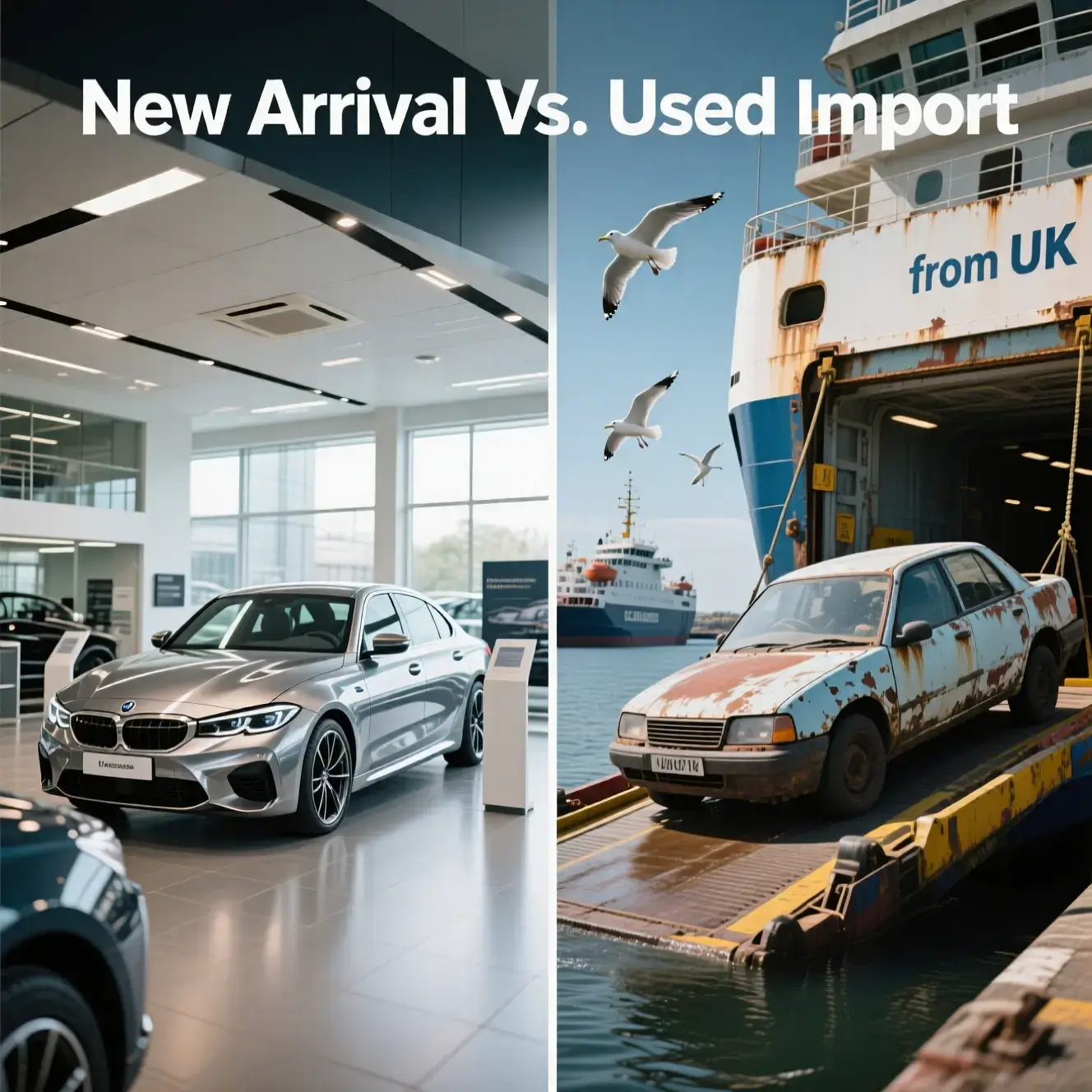
Here's a question I get more than any other: "Is it cheaper to buy a new car abroad and import it, or should I just buy a used one locally?"
People assume new cars must be more expensive, tax-wise. Or that used cars are automatically the better deal. The truth is more complicated. The way VRT interacts with new versus used cars is fundamentally different, and depending on the car you choose, one option can save you thousands over the other.
I've seen people import a brand-new BMW from Germany and save €8,000 versus the Irish dealer price. I've also seen people import a three-year-old Ford from England and end up paying more in total than if they'd just bought locally. Let me explain why, and help you figure out which route makes sense for you.
The Fundamental Difference Between New and Used VRT
Here's the thing that most people don't realise: when you buy a brand-new car from an Irish dealer, the VRT is already baked into the price. The dealer pays VRT when they register the car, and they pass that cost on to you. You never see a separate VRT line on your invoice. It's just part of the €35,000 you pay.
When you import a used car yourself, VRT is a separate bill that arrives after you've already paid for the car. You see the exact amount, and you feel it. It's a psychological difference as much as a financial one.
But the actual mechanics of how VRT is calculated are different too. For a used import, Revenue assesses the OMSP (Open Market Selling Price) based on the Irish market value of a car of that age, mileage, and condition. For a new car that's being registered for the first time in Ireland, VRT is calculated on the vehicle's OMSP as a new car - which is essentially the Irish retail price minus VRT and VAT.
That last bit is important, so let me spell it out. If a new car sells for €40,000 in an Irish showroom, that price includes VRT and VAT. To calculate VRT on that car, Revenue first strips out the VRT and VAT to get the OMSP, then applies the VRT rate to the OMSP. It's circular, but it works out so that the total price you pay includes the correct VRT.
For a used import, there's no circular calculation. Revenue just looks at comparable Irish cars on the market, determines an OMSP for your car in its current condition, and applies the VRT percentage. Simple, but potentially surprising.
How VRT Rates Differ: New vs Used
The VRT rate itself - the percentage applied to the OMSP - is the same whether the car is new or used. It's based on the CO2 emissions band, and the bands don't change based on the car's age. A 2024 car with 110g/km CO2 pays 11% VRT. A 2014 car with 110g/km CO2 also pays 11% VRT.
So the rate doesn't change with age. But the OMSP does. That's the key difference.
For used imports, Revenue applies an age-related depreciation to the OMSP. The older the car, the lower the OMSP, and therefore the lower the VRT. But here's the gotcha: the depreciation might not match what you think the car is worth. Revenue has its own depreciation schedule that can be more conservative (meaning less depreciation) than the actual market would suggest.
Let me show you what I mean with a comparison:
| Car Age | Approximate OMSP Depreciation | Impact on VRT |
|---|---|---|
| Less than 1 year | 5-10% off new price | VRT nearly as high as new |
| 2-3 years | 15-25% off new price | Moderate VRT saving vs new |
| 4-5 years | 30-40% off new price | notable VRT saving |
| 6-10 years | 45-60% off new price | Low VRT, but car is older |
| 10+ years | 60-75% off new price | Very low VRT |
The depreciation means that importing an older used car results in lower VRT. But the purchase price might also be lower, so the absolute saving versus buying in Ireland might be smaller. There's a sweet spot, and we'll find it below.
Buying New Abroad vs Buying New in Ireland
Let's tackle the new car question first because it's often misunderstood. Can you save money by buying a new car in another country and importing it to Ireland?
The answer depends on where you buy:
Buying new from the UK
This used to be a popular strategy. Before Brexit, you could buy a new car in the UK, drive it to Ireland, pay VRT, and save thousands. The UK market had lower prices, and there was no customs barrier.
Post-Brexit, it's less attractive. You now pay 10% customs duty on the purchase price, plus 23% VAT on top of that, plus VRT at registration. The savings have largely evaporated for most cars.
Example: A new Volkswagen Golf 1.5 TSI in the UK costs about £28,000 (€32,200). The same car in Ireland costs around €35,000. Let's see if importing saves anything:
- Purchase price: €32,200
- Shipping: €400
- Customs value: €32,600
- Customs duty at 10%: €3,260
- Value for VAT: €35,860
- VAT at 23%: €8,247.80
- Import taxes: €11,507.80
Now VRT. This is tricky for a new car that's never been registered before. Revenue calculates VRT on the OMSP of the car as new. For a Golf 1.5 TSI, the OMSP might be around €28,000 (the Irish price minus VRT and VAT). CO2 emissions are about 130g/km (Band B1, 15%). VRT = €28,000 x 15% = €4,200. NOx levy: maybe €350. Total VRT: €4,550.
Total landed: €32,200 + €400 + €11,507.80 + €4,550 = €48,657.80.
Irish dealer price: €35,000. You'd be paying nearly €14,000 more by importing. The strategy is dead for mainstream new cars from the UK.
Buying new from the EU
This is more viable. No customs duty (EU single market). No import VAT (if VAT is accounted for within the EU). You just pay VRT at registration.
A new car purchased from a German or French dealer and imported to Ireland can work out cheaper if the EU list price is notably lower than the Irish one. This happens most often with high-end cars where Irish dealers add wide margins.
Example: A new Mercedes-Benz E-Class in Germany might cost €55,000 versus €68,000 in Ireland. You pay €55,000, arrange transport for €500, then VRT on an OMSP of maybe €58,000. CO2 around 140g/km (Band B2, 16%). VRT = €58,000 x 16% = €9,280. NOx: €500. Total VRT: €9,780.
Total landed: €55,000 + €500 + €9,780 = €65,280.
Irish dealer price: €68,000. You'd save about €2,720. Not life-changing, but real. For a high-spec S-Class where the price gap is bigger, the saving can be €10,000 or more.
Buying new from outside the EU
Buying a new car from Japan, the US, or the UAE and importing it to Ireland rarely makes financial sense for mainstream cars. The customs duty and VAT stack up to a massive bill. Add shipping costs, and you're usually worse off than buying locally.
The exception is for cars that aren't available in Ireland at all. If you want a specific American pickup truck or a Japanese sports car that was never sold here, you have no choice but to import. In that case, the tax bill is just the cost of getting the car you want.
Buying Used Abroad: Where the Savings Are
Used car imports are where most of the action is. The potential savings come from two sources: lower purchase prices in the source country, and lower VRT due to age-related OMSP depreciation.
Used from the UK
This is still the most common route despite Brexit. The UK used car market is large, prices are competitive, and there's a good selection of RHD cars.
Here's a realistic example. A 2020 BMW 3 Series 320d M Sport. UK purchase price: £18,000 (€20,700). Shipping: €400. Customs value: €21,100. Customs duty: €2,110. Value for VAT: €23,210. VAT: €5,338.30. Import taxes: €7,448.30.
VRT: OMSP assessed at €23,000. CO2 around 135g/km (Band B2, 16%). VRT = €23,000 x 16% = €3,680. NOx: €800. Total VRT: €4,480.
Total landed: €20,700 + €400 + €7,448.30 + €4,480 = €33,028.30.
Irish dealer price for a similar car: about €32,000 to €35,000. You're right in the same ballpark. The import saves maybe €500 if you're lucky, and you've taken on all the risk and hassle.
So why do people still import used cars from the UK? For specific models, the price difference is bigger. High-performance cars, niche models, or cars with unusual specifications can be notably cheaper in the UK. A 2021 Audi RS3 might be €45,000 in the UK and €55,000 in Ireland. Even after taxes, you could save €5,000 to €8,000.
Used from the EU
For used cars from EU countries, you avoid customs duty and import VAT. This is a big advantage. You pay the purchase price, transport, and VRT only.
A 2021 Volkswagen ID.4 from Germany. Purchase price: €27,000. Transport: €500. OMSP in Ireland: €29,000. As an EV, the VRT rate is reduced (check current rules - it's been changing). Assuming Band A1 at 7%: VRT = €29,000 x 7% = €2,030. No NOx levy on an EV. Total VRT: €2,030.
Total landed: €27,000 + €500 + €2,030 = €29,530.
Irish dealer price: around €33,000 to €35,000. You'd save €3,500 to €5,500. That's real money. And it's an LHD car, which for an EV that you'll charge at home, probably doesn't matter much.
Used from Japan
Japanese imports are a niche market, but the savings can be dramatic for the right car. Low purchase prices at Japanese auctions offset the high shipping and import taxes.
A 2018 Subaru WRX STI. Japanese auction price: €14,000. Shipping and insurance: €2,200. Customs value: €16,200. Customs duty: €1,620. Value for VAT: €17,820. VAT: €4,098.60. Import taxes: €5,718.60.
VRT: OMSP around €18,000. CO2 high - maybe 240g/km (Band F, 23%). VRT = €18,000 x 23% = €4,140. NOx levy: hitting the €4,850 cap. Total VRT: €8,990.
Total landed: €14,000 + €2,200 + €5,718.60 + €8,990 = €30,908.60.
Irish market price for a similar STI: €35,000 to €40,000 if you can find one. The saving is genuine, but you're paying nearly €15,000 in taxes. You need to really, really want that specific car.
New vs Used: Which One Saves More?
Here's my honest take after crunching the numbers on dozens of scenarios.
For mainstream cars (Golf, Focus, Corolla, etc.): Buying new from Ireland is usually the best option. The price difference after all taxes and hassle isn't worth it. For used, importing from the UK rarely saves much on mainstream models either. You're better off buying a used car from an Irish dealer or privately in Ireland.
For premium cars (BMW, Audi, Mercedes, etc.): Buying new from the EU can save 5% to 15% versus the Irish dealer price. For used, the UK market offers real savings on high-spec or performance variants, even after import taxes.
For electric cars: Importing from the EU makes sense because you avoid customs duty, and VRT on EVs is lower. The German EV market is more competitive than Ireland's, especially for nearly-new cars.
For niche and performance cars: Importing from wherever you can find the right car is the only option. Japanese imports, American muscle, rare German performance models - if you want something specific, you import it and pay what it costs.
For budget used cars (under €10,000): Importing rarely makes financial sense. The import taxes eat up too much of the saving. Buy locally.
The Hidden Costs of Importing New vs Used
VRT and customs aren't the only costs. Here are the expenses that often get forgotten:
Transport: Shipping a used car from the UK costs €300 to €500. From Japan, it's €1,500 to €2,500. From the US, it's €1,500 to €3,000. For a new car from Germany, you might pay €400 to €800 for a transporter, or drive it yourself and pay for fuel and ferries.
Customs agent: €100 to €250 for a professional to handle your customs clearance. You can do it yourself for free, but it's tedious and error-prone.
NCTS appointment: The VRT inspection itself doesn't have a separate fee in most cases, but if you need to reschedule or bring the car back for a re-inspection, there are charges.
Modifications: If you're importing a non-EU car, you might need to modify headlights, rear indicators, speedometer, or add fog lights. Budget €500 to €2,000 for this.
Currency exchange: If you're buying in GBP, USD, or JPY, the exchange rate between purchase and payment can shift by several percent. That's real money on a €20,000 car.
Insurance during transport: You need transit insurance for the journey. Usually €100 to €300.
Storage: If there's a delay at customs or the NCTS, your car might sit at the port or a compound. Storage fees add up fast - €20 to €50 per day.
These hidden costs can easily add €1,000 to €3,000 to any import. Factor them in, especially for cheaper cars where they make up a larger percentage of the total.
Which Strategy Works Best for Different Scenarios
Scenario 1: You want a reliable family car, budget is €15,000
Buy a used car from an Irish dealer. A 2018 Toyota Corolla or similar can be found within budget, no import hassle, no tax surprises. Importing from anywhere won't save you enough to justify the headache.
Scenario 2: You want a nearly-new EV, budget is €35,000
Look at the German used EV market. A one-year-old VW ID.4 or Tesla Model 3 can be €5,000 to €8,000 cheaper than Irish dealer prices. Even after transport and VRT, you'll save thousands.
Scenario 3: You want a specific performance BMW, budget is €50,000
Check the UK market. An M340i or M440i might be €8,000 to €12,000 cheaper in the UK than in Ireland. After import taxes, you could still save €3,000 to €6,000. Worth the paperwork.
Scenario 4: You're moving home to Ireland and own a car abroad
Look into Transfer of Residence relief. If you've owned the car for at least 6 months and lived abroad for at least 12 months, you might avoid customs duty and VAT. You'll still pay VRT, but the saving on import taxes can be massive.
Scenario 5: You want a Japanese sports car that was never sold in Ireland
You import it. There is no Plan B. Just make sure you understand the total landed cost before you bid at auction.
What About Importing a Nearly-New Car?
The nearly-new category - cars under 12 months old with low mileage - is its own special case. These cars are technically used, but they're close enough to new that the VRT calculation works differently.
Revenue's OMSP for a nearly-new car will be very close to the Irish new-car price. The depreciation is minimal. So you're paying almost as much VRT as you would on a brand-new car, but you're importing a used car with all the import tax complications.
This is the worst category for importing, in my opinion. You get the worst of both worlds: you pay customs duty and VAT (if from the UK or non-EU), you pay near-new VRT, and you end up with a car that's not new but costs almost as much as one. Nearly-new imports only make sense if the purchase price in the source country is dramatically lower than Ireland, or if you're getting the car from a family member for a nominal amount.
The sweet spot for importing is usually cars that are 3 to 5 years old. By that age, the OMSP has depreciated enough to make VRT reasonable, but the car is still modern enough to be reliable and efficient. Cars in this age bracket from Germany (for LHD) or the UK (for RHD) offer the best balance of saving and practicality.
Final Thoughts on the VRT Depreciation Question
There's a misconception floating around that Revenue unfairly inflates OMSPs for imported used cars. Some people claim Revenue values imported cars higher than comparable Irish-registered cars. In my experience, this isn't systematically true. Revenue uses the same market data for all valuations. But what can happen is that the specific car you imported - with its particular mileage, options, and condition - gets valued differently than you expected.
The best way to protect yourself: get a ROS VRT estimate before you buy. It takes 10 minutes to fill in the form online. The estimate isn't binding, but it gives you a realistic range. If the estimate comes back at €5,000 and you were banking on €3,000, you can make an informed decision before you spend money on shipping and customs.
And if you're importing a new car, don't assume it's automatically a bad idea. For the right car from the right country, it can work. Just run all the numbers first and compare against the Irish dealer price including any discounts they might offer. Sometimes the Irish dealer will match or beat the import price if you negotiate.
My Verdict: New vs Used
If I had to give a simple answer, here it is: for most people, buying a used car in Ireland is the smartest financial move. The import process adds stress, uncertainty, and cost that often outweighs the potential savings.
But for specific circumstances - premium cars, EVs from Germany, performance cars from the UK, or anything you can't find in Ireland - importing is absolutely worth doing. The key is knowing your numbers before you commit. Don't guess. Don't rely on what a mate told you. Run the full landed cost calculation for your specific car, and then decide.
Our VRT calculator on this site is a good starting point. Revenue's own VRT enquiry tool is the official source. Use both, compare the results, and budget for the higher figure. That way, you won't get a nasty surprise when the NCTS inspector hands you the bill.
The bottom line? There's no universal answer to new versus used when it comes to VRT. Every car, every country, every set of circumstances gives a different answer. But if you take one thing from this guide, let it be this: calculate the full landed cost before you fall in love with a car abroad. The numbers will tell you whether the deal makes sense. If they don't add up, walk away. There will always be another car.