You find a car you like online. A 2019 Audi A4, 1.6 litre diesel, 50,000 miles on the clock. The UK dealer says the CO2 is 110g/km. You run the numbers through a VRT calculator and the tax looks manageable. Maybe you budget around €3,500 for VRT and move ahead with the purchase.
Then you get to the VRT appointment, and Revenue tells you the CO2 figure is actually 130g/km. When you book your VRT inspection, you will visit an NCTS (National Car Testing Service) centre, where they verify your vehicle's details before registration. Your VRT jumps by €800. What happened? Did the car get dirtier on the boat? No. It's just that the UK ad quoted the old NEDC figure, and Revenue uses the WLTP figure. Same car, different test. Different tax bill.
This confusion happens all the time. I've talked to dozens of importers who got caught out by the difference between WLTP and NEDC, and it's one of the most common reasons people end up paying more VRT than they expected. Let me explain what these standards are, why they give different numbers, and how to make sure you're using the right one.
What Is NEDC? The Old Way of Measuring Emissions
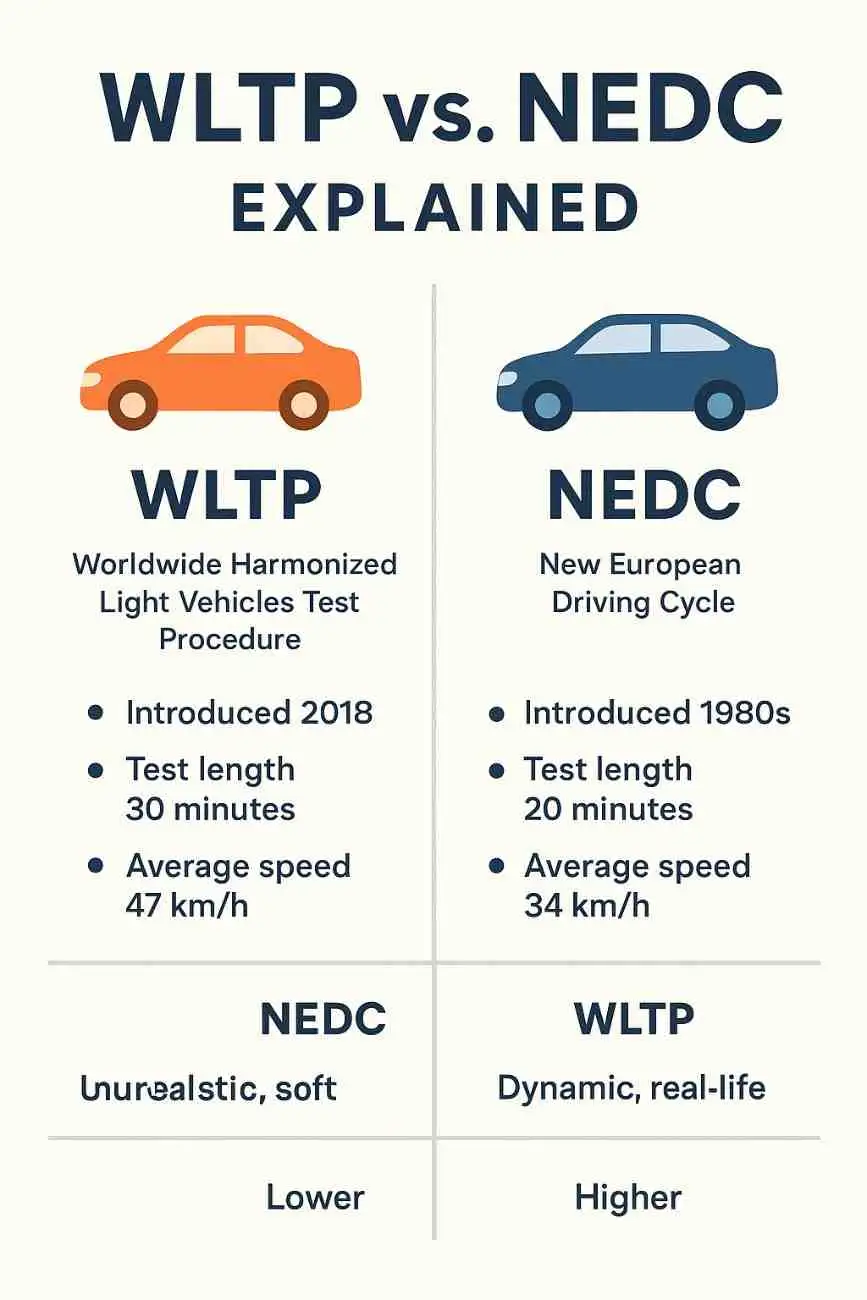
NEDC stands for New European Driving Cycle. It was developed in the 1980s, and it was used across Europe to measure vehicle fuel consumption and CO2 emissions for decades. If you imported a car that was first registered before 2021, its official CO2 figure was almost certainly measured using NEDC.
The problem with NEDC is that it was designed in a lab, not on the road. The test cycle was fixed. It used predetermined acceleration and deceleration patterns that didn't reflect how real people drive. The test was also relatively short about 20 minutes with an average speed of just 34 km/h. The acceleration was gentle, the gear changes were optimised, and all the ancillary loads like air conditioning were switched off.
Manufacturers got very good at optimising their cars to perform well on the NEDC test. Some even designed their gear ratios specifically to achieve better NEDC numbers. The result was that a car might show CO2 emissions of 120g/km on the test, but in real-world driving, it was actually emitting 150g/km or more.
This gap between test results and real-world performance became a big issue. It wasn't just about VRT either. Car tax bands across Europe were based on these figures, so people were paying lower tax than they should have been based on their actual emissions. And for climate policy, the whole system was giving a misleading picture of what cars were really putting out.
The Specific Problems With NEDC
- The test cycle was too smooth. Real driving involves hills, traffic, sudden stops, and aggressive acceleration. NEDC assumed you drove like you had a full cup of coffee on the dashboard.
- The ambient temperature was set to a comfortable 20 to 30 degrees Celsius. Cold starts and winter driving, which increase emissions notably, were not considered.
- Optional equipment that adds weight and drag was not included in the test. So a car with larger wheels, a sunroof, or a tow bar would have the same NEDC figure as a stripped-out base model, even though in reality it would use more fuel.
- The test was too short to accurately measure emissions from modern engines, especially diesels with complex after-treatment systems that take time to warm up.
These aren't minor issues. Research by the International Council on Clean Transportation found that the gap between NEDC test results and real-world fuel consumption grew from about 8% in 2001 to over 40% by 2014. The test was becoming less meaningful every year.
What Is WLTP? The Modern Replacement
WLTP stands for Worldwide Harmonised Light Vehicles Test Procedure. It was developed by the United Nations Economic Commission for Europe (UNECE) and was introduced to replace NEDC with something more realistic. It's been the standard for all new car type approvals in Europe since September 2018, and for all new car registrations since 2021.
WLTP is a notable improvement over NEDC. The test cycle is longer 30 minutes instead of 20 and covers a wider range of driving conditions. It includes four distinct phases: low speed (urban driving), medium speed (suburban), high speed (rural), and extra-high speed (motorway). The average speed is higher at 47 km/h, and the maximum speed goes up to 131 km/h.
More importantly, WLTP tests are more demanding. The acceleration is more aggressive, the gear shifts are not pre-determined, and the test accounts for the vehicle's optional equipment. If your car has 19-inch wheels instead of 17-inch wheels, the WLTP test takes that into account. Under NEDC, it wouldn't have mattered.
The result is that WLTP figures are typically 15 to 25% higher than NEDC figures for the same car. That sounds like the cars got dirtier, but they didn't. What actually happened is that the measurement became more honest.
Key Improvements With WLTP
- Realistic driving profiles that include acceleration, braking, and different speed ranges that match actual road conditions.
- Temperature testing at 23 degrees Celsius but with additional cold weather tests at 14 degrees to account for winter driving.
- Individualised testing based on the car's actual specification, not a generic base model. This means the weight, aerodynamics, and rolling resistance of your specific car's options are factored in.
- A longer test cycle that gives more accurate data for modern engines, particularly diesels that need time to reach operating temperature.
If you look at a WLTP certificate for a modern car, you'll notice it often gives a range of CO2 values rather than a single number. That's because the test accounts for different configurations. A car with automatic transmission, bigger wheels, and a sunroof will show higher CO2 than the same car with a manual gearbox, steel wheels, and no options.
Which Standard Applies to Your Car?
This is where a lot of people get confused, so let me make it simple.
If your car was first registered in 2021 or later, it should have WLTP CO2 figures. That's the standard that applies, and Revenue will use the WLTP value when calculating your VRT. You can find the WLTP figure on the Certificate of Conformity (CoC) or on the manufacturer's technical data sheet for the vehicle.
If your car was first registered between September 2018 and the end of 2020, it depends on when the car's type approval was issued. Some cars from this period have WLTP figures, others have NEDC figures, and some have both. Revenue in Ireland generally accepts NEDC values for cars registered before 2021, but they may also have access to WLTP data. If you're importing such a car, check both values and see which one Revenue uses.
If your car was first registered before September 2018, you'll almost certainly have NEDC figures only. That's what Revenue will use. You don't need to worry about converting to WLTP because the old standard is the one that determines your tax.
I've noticed a lot of confusion around cars registered in 2020. Some manufacturers had WLTP data available before it was mandatory, while others didn't. If you're buying a 2020 car, ask the seller for the Certificate of Conformity and check which CO2 figure is listed. If they can't provide it, you can usually find the information from the manufacturer using the VIN number.
How CO2 Bands Work for VRT
VRT in Ireland is calculated based on a percentage of the car's OMSP (Open Market Selling Price), and that percentage depends on the car's CO2 emissions. The lower the emissions, the lower the percentage. The higher the emissions, the more you pay.
Here's how the bands work for 2026 and 2026:
- 0 to 90g/km: 7% of OMSP
- 91 to 100g/km: 9%
- 101 to 110g/km: 11%
- 111 to 120g/km: 13%
- 121 to 130g/km: 15%
- 131 to 140g/km: 17%
- 141 to 155g/km: 19%
- 156 to 170g/km: 23%
- 171 to 190g/km: 27%
- Above 190g/km: 41%
Notice that big jump at the end. Cars with CO2 above 190g/km jump from 27% to 41%. That's an extra 14% on whatever the OMSP is. On a €30,000 car, that's an extra €4,200. And this is where the difference between WLTP and NEDC really matters.
Say you're looking at a car that has an NEDC figure of 180g/km. Under NEDC, it falls in the 27% bracket. But if you're looking at the WLTP figure for the same car, it might be 195g/km. Under WLTP, it jumps to 41%. The difference in VRT on a €30,000 OMSP would be €4,200 between the two calculations.
I've seen this exact scenario play out more times than I can count. Someone buys a car thinking the VRT will be around €8,100 based on the NEDC figure, and they end up paying €12,300 because Revenue uses the WLTP figure. It's a nasty surprise, and it's completely avoidable if you check both numbers before you buy.
How to Find Your Car's Correct CO2 Value
If you're importing a car and you need to find the correct CO2 figure for VRT, here's where to look.
Certificate of Conformity (CoC)
This is the gold standard. Every car manufactured in Europe comes with a Certificate of Conformity that lists the official CO2 emissions. The CoC will clearly state whether the figure is NEDC or WLTP. If you're buying from a UK dealer, ask them to send you a copy of the CoC before you commit. If they can't provide it, that's a red flag.
Manufacturer Technical Data
Most manufacturers have online databases where you can look up a car's technical specifications using the VIN. BMW, Audi, Mercedes, and Volkswagen all have these tools. You'll need the full 17-digit VIN, and the data will usually give you both NEDC and WLTP figures where available.
UK Vehicle Registration Document (V5C)
The V5C logbook for UK-registered cars lists the CO2 emissions in section 7. However, it doesn't always specify whether this is NEDC or WLTP. For cars registered before 2021, it's almost certainly NEDC. For cars registered from 2021 onward, it should be WLTP. But there are edge cases, especially for cars registered in late 2020 that may have WLTP figures recorded.
Revenue's Online VRT Enquiry
You can use Revenue's own VRT enquiry system to get an estimate. When you enter the car's details, the system will tell you what CO2 figure they have on record. This is the figure they'll use, so if it doesn't match what you expected, you know in advance rather than at the VRT appointment.
What the Difference Actually Costs You
Let me give you some concrete examples so you can see how this plays out in real money.
Case Study 1: Family Diesel Estate
Car: 2019 BMW 3 Series Touring 320d NEDC CO2: 112g/km WLTP CO2: 132g/km (approximate conversion) OMSP: €22,000
At 112g/km NEDC, the VRT rate is 13%. That's €2,860. At 132g/km WLTP, the VRT rate is 17%. That's €3,740. Difference: €880 extra with WLTP.
For this car, the difference is noticeable but not catastrophic. It's about the same as the NOx levy on a diesel. Annoying, but not a deal-breaker.
Case Study 2: Compact Petrol SUV
Car: 2021 Volkswagen Tiguan 1.5 TSI NEDC CO2: 128g/km WLTP CO2: 152g/km OMSP: €27,000
At 128g/km NEDC, the VRT rate is 15%. That's €4,050. At 152g/km WLTP, the VRT rate is 19%. That's €5,130. Difference: €1,080 extra with WLTP.
Again, a notable bump. The car is a 2021 model, so WLTP is the correct standard. If you were looking at the NEDC figure thinking you'd pay €4,050, you'd be in for a shock.
Case Study 3: Performance Diesel
Car: 2016 Audi A6 3.0 TDI NEDC CO2: 138g/km (WLTP wasn't measured for this car) OMSP: €18,000
This car only has NEDC figures because it was registered before WLTP was introduced. At 138g/km NEDC, the VRT rate is 17%. That's €3,060.
If WLTP had been applied to this car, its real-world CO2 would probably be around 165 to 175g/km, which would put it in the 23% or even 27% bracket. The difference could easily be €1,000 to €1,800 more. But because the car was registered before 2021, NEDC is what applies, and the buyer benefits from the older, lower figure.
This is why the timing of your import matters. If you import a car from the transition period (2018 to 2020), the applicable standard can be the difference between a reasonable VRT bill and a painful one.
What Happens When Revenue Uses the Wrong Standard
Sometimes Revenue applies the wrong CO2 standard to a car. I've seen cases where a car registered in 2020 had NEDC figures on its CoC but Revenue used the WLTP figure. In other cases, the opposite happened. If you think Revenue has used the wrong standard, you can appeal.
The key piece of evidence is the Certificate of Conformity. If your CoC clearly states the CO2 figure and the testing standard, and Revenue has used a different figure, you have grounds for an appeal. I've heard from people who successfully had their VRT reassessed after providing the correct CoC data.
One thing to be aware of is that Revenue has access to their own database of CO2 values. Sometimes their database shows a different figure than what's on your CoC. If that happens, you need to ask them where their figure came from and why it differs from the manufacturer's official data.
Tips for Avoiding CO2 Surprises
Here's what I'd recommend to avoid getting caught out by the WLTP versus NEDC issue.
Always check the Certificate of Conformity before you buy. Don't rely on what the dealer's ad says. Dealers often quote the NEDC figure because it's lower and makes the car look cleaner and more tax-efficient. Ask for the CoC and read the CO2 figure yourself.
If you're looking at a car from 2018 to 2020, be extra careful. This is the transition period where some cars have WLTP data and others don't. Check the car's exact registration date and find out what standard applies.
Use the VRT calculator with the correct standard. Our calculator lets you choose between NEDC and WLTP. Make sure you select the right one for your car. If you're not sure, use the WLTP figure as a worst-case estimate, because that's probably what Revenue will use for newer cars.
Factor in a buffer. Even if you're confident about the CO2 figure, keep 10 to 15% extra in your budget for VRT. There are other variables that can affect the final bill, like the OMSP, the NOx levy, and any changes in rates between when you budget and when you register.
Ask Revenue directly. You can use Revenue's VRT enquiry system to get a formal estimate before you import. It's not binding, but it gives you a good idea of what to expect. If there's a discrepancy between what you think the CO2 is and what Revenue thinks it is, you'll find out early.
The Future of Emissions Testing
WLTP isn't the end of the story. The testing standards continue to evolve. There's already work underway on WLTP Phase 2, which will introduce even more realistic testing conditions. The European Commission is also looking at how real-world emissions monitoring can be integrated with the laboratory tests.
For Ireland specifically, the trend is clear. CO2-based VRT rates are becoming more important, not less. The government is using the tax system to push people toward lower-emission vehicles. If you're importing a car, the CO2 figure isn't just a number on a form. It's the single biggest factor in how much VRT you'll pay (after the OMSP itself).
Understanding the difference between WLTP and NEDC isn't just academic. It's a practical tool that can save you hundreds or thousands of euros. Check the standard, check the figure, and don't assume the lower number is the one that applies to your import.
A Quick Reference: NEDC vs WLTP at a Glance
To wrap up, here's a simple comparison that sums up the key differences between the two standards. NEDC was developed in the 1980s, it lasted about 20 minutes, and it gave CO2 figures that were often 15 to 25% lower than reality. It was based on gentle, idealised driving with no optional equipment factored in. WLTP came into use from 2018 onward, it runs for 30 minutes with more realistic driving patterns, and it accounts for the car's actual specification including optional extras.
For VRT purposes, here's the bottom line. If your car was registered in 2021 or later, use WLTP. If it was registered before 2018, use NEDC. If it's from the transition period between 2018 and 2020, check the Certificate of Conformity carefully to see which standard applies. And if you're not sure, assume the higher WLTP figure for budgeting purposes, because that's likely what Revenue will use.
Getting this wrong can cost you real money. But now that you know the difference, you won't get caught out the way so many importers do.
Want a deeper side-by-side breakdown? See our full NEDC vs WLTP comparison with technical specs, worked examples, and a band-by-band impact table.
Common Questions About WLTP and NEDC
Let me answer a few questions I get asked all the time about these two standards.
Can I use the NEDC figure if my car has both? For VRT purposes, Revenue uses the WLTP figure if it's available. If your car has both values on the Certificate of Conformity, Revenue will use the WLTP one. You can't choose the lower figure just because it's more favourable.
What if Revenue's database has the wrong value? This happens more often than you'd think. If Revenue has an incorrect CO2 figure for your car, you can appeal. The Certificate of Conformity is your main evidence. If it shows a different figure from what Revenue is using, provide a copy and ask them to correct it. I've seen cases where this saved people hundreds of euros.
Does the NOx levy use WLTP or NEDC? The NOx levy is based on NOx emissions, not CO2. The testing standard for NOx is separate from the CO2 standard. For most cars, the NOx figure is measured using the same test cycle as the CO2 figure, so if your CO2 is WLTP, your NOx is probably WLTP too. But check the specific figures on your CoC to be sure.
Will WLTP be replaced? Yes, eventually. WLTP Phase 2 is in development, and there's ongoing work on real-world emissions testing that will supplement the laboratory tests. But WLTP will be the primary standard for Irish VRT purposes for the foreseeable future. Don't expect a change anytime soon.