You've found the perfect car. A 2016 diesel estate, ideal for the school run and the weekly shop. The price is right, the mileage is reasonable, and the seller has full service history. You're about to shake on it when someone mentions the NOx levy. Suddenly that reasonable price doesn't look so reasonable anymore.
The NOx levy catches more people out than almost any other part of the VRT system. It's not new, but it's easy to forget about when you're focused on the car's price, its mileage, and its condition. And for diesel cars especially, it can add thousands to your bill.
I've put this guide together to explain exactly what the NOx levy is, how it's calculated, which cars are affected, and whether there's anything you can do about it. By the time you finish reading, you'll know exactly what you're facing.
What actually is the NOx levy?
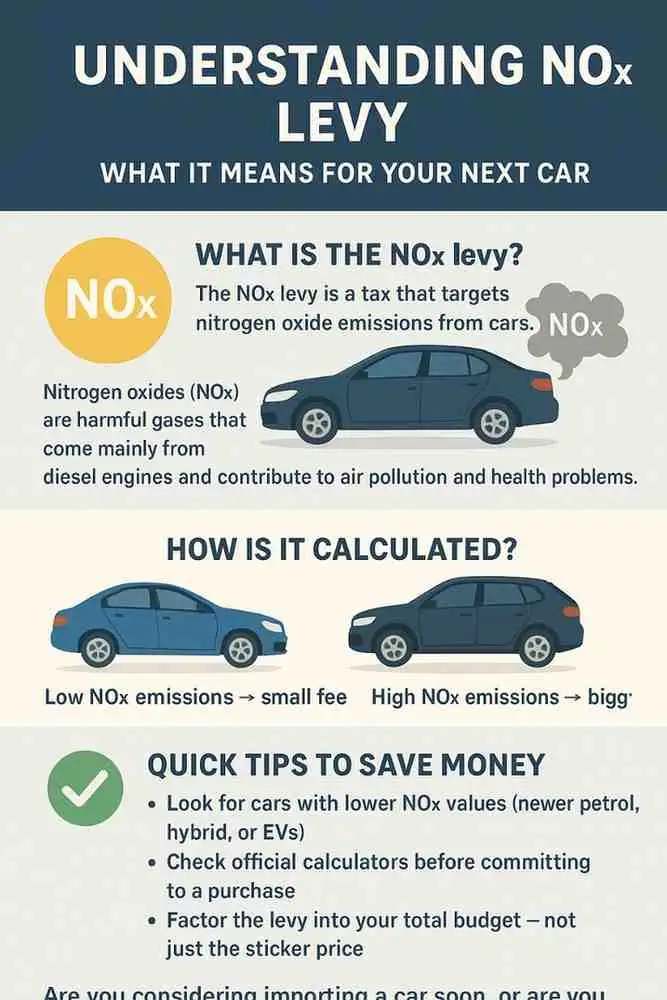
The Nitrogen Oxide levy, better known as the NOx levy, is an additional charge on top of your standard VRT. It was introduced by the Irish government as part of the Climate Action Plan, and the aim is simple: make higher-polluting cars more expensive to register, to discourage people from buying them.
It applies to every passenger vehicle being registered in Ireland for the first time, whether you're importing it or buying it new. Once complete, your vehicle receives an IRN (Irish Registration Number) and can be driven legally on Irish roads. The amount you pay depends entirely on how much nitrogen oxide the car emits, measured in milligrams per kilometre driven.
Now, I'm not going to pretend NOx is something most of us think about. But here's what you need to know: nitrogen oxides are gases produced mainly by diesel engines. They're bad for air quality and bad for our health. The levy is designed to make you think twice before buying a high-emission diesel.
Why NOx emissions matter
I should explain why the government specifically targets NOx rather than just CO2. Nitrogen oxides are a group of gases, mostly nitric oxide and nitrogen dioxide, that are produced when fuel burns at high temperatures. Diesel engines run hotter and leaner than petrol engines, which means they produce more NOx.
The health effects are well documented. NOx can cause respiratory problems, aggravate asthma, and contribute to the formation of particulate matter. The World Health Organisation has identified NOx as a major air pollutant, and cities across Europe have introduced low-emission zones specifically targeting diesel vehicles.
In Ireland, the transport sector is a major source of NOx emissions. The Climate Action Plan includes measures to reduce these emissions, and the NOx levy is one of the most direct tools the government has. By making high-NOx vehicles more expensive to register, they're trying to shift the market towards cleaner options.
Whether you agree with the policy or not, the levy is here to stay. Understanding why it exists might not make it cheaper, but it explains why the government is unlikely to reduce it anytime soon.
How the levy is calculated
The NOx levy uses a sliding scale based on the vehicle's NOx emissions in mg/km. The higher the emissions, the more you pay. Here's how the bands work.
For vehicles with NOx emissions up to 60 mg/km, the charge is 5 per mg/km. Between 61 and 80 mg/km, it jumps to 15 per mg/km for that portion. From 81 to 100 mg/km, it's 25 per mg/km. And above 100 mg/km, you're looking at 50 per mg/km.
Let me give you a real example. A 2016 Volkswagen Golf 2.0 TDI emits around 180 mg/km of NOx. The calculation goes like this: the first 60 mg costs 300 (60 x 5). The next 20 mg (from 61 to 80) costs another 300 (20 x 15). The next 20 mg (81 to 100) costs 500 (20 x 25). And the remaining 80 mg (101 to 180) costs 4,000 (80 x 50).
Total NOx levy on that Golf? 5,100. Add that to the standard VRT, and you're looking at a notable bill.
The minimum NOx levy is 25, and the maximum is 4,850. Yes, you read that right. Some diesel cars can attract a levy of nearly five thousand euros before you've even paid a cent of standard VRT.
Which vehicles are affected
Mostly diesels. Petrol cars generally produce much less NOx, so their levy is much lower or even zero. Hybrids and EVs produce minimal NOx, so they're largely unaffected.
But within the diesel category, there's huge variation. A modern diesel with advanced emissions technology might emit under 60 mg/km, giving it a very low levy. An older diesel without that technology can easily exceed 150 mg/km, resulting in a hefty charge.
The real problem cars are the ones from around 2011 to 2018, before manufacturers really started cleaning up diesel emissions. Cars like the BMW 3 Series diesel, the Audi A4 diesel, and the Ford Focus diesel from that era tend to have higher NOx readings. If you're looking at a diesel from this period, check the NOx value before you commit.
Petrol cars typically emit between 20 and 60 mg/km, so their levy is usually in the 100 to 300 range. Modern petrols, especially those with turbochargers and direct injection, can be a bit higher, but nowhere near diesel territory.
Electric cars produce zero NOx emissions from the tailpipe. Their NOx levy is zero. This is one of the reasons EVs can be so attractive from a VRT perspective, even before you factor in the EV relief.
Hybrids sit somewhere in between. A plug-in hybrid that runs mostly on electricity will have low NOx emissions. A mild hybrid that's basically a petrol engine with a small battery assist will be closer to a normal petrol car.
How to find your vehicle's NOx value
This is the bit people struggle with. The NOx value isn't always easy to find, especially on older imports. Here's where to look.
First, check the Certificate of Conformity, or CoC. This is the document that comes with every new car sold in the EU, and it lists the vehicle's emissions data, including NOx. If you're importing a car, the seller should be able to provide the CoC.
Second, check the vehicle's registration document. In the UK, for example, the V5C logbook sometimes lists NOx emissions. In other countries, it might be on a separate emissions certificate.
Third, use an online database. There are websites where you can look up a vehicle's emissions by make, model, year, and engine size. These are based on official EU type-approval data, so they're reasonably accurate. The Revenue's own VRT calculator also pulls this data when you enter a vehicle's details. When you book your VRT inspection, you will visit an NCTS (National Car Testing Service) centre, where they verify your vehicle's details before registration.
Fourth, check the manufacturer's specifications. Most car manufacturers publish technical data for their models. If you know the exact model and engine, you can often find the NOx value in the technical specs.
Here's the thing though. The Revenue uses the WLTP (Worldwide Harmonised Light Vehicles Test Procedure) value for cars tested after September 2017. For older cars, they use the NEDC (New European Driving Cycle) value. The WLTP values tend to be higher because the test is more realistic. So a car tested under WLTP will generally show higher NOx emissions than the same car tested under NEDC, which means a higher levy.
If you can't find the NOx value anywhere, Revenue will use a default value based on the vehicle's category and age. The default is usually on the higher side, so it's in your interest to find the actual figure if you can.
WLTP versus NEDC and why it matters for your levy
This is a crucial detail that affects your NOx levy more than most people realise. Before September 2017, cars were tested under the NEDC system, which was a laboratory test that didn't reflect real driving conditions. After September 2017, the WLTP system was introduced, which is more realistic and generally produces higher NOx readings.
Here's why this matters. A car tested under NEDC might show NOx emissions of 80 mg/km. The same car, tested under WLTP, could show 120 mg/km. The difference in your NOx levy could be hundreds or even thousands of euro.
When Revenue assesses a car, they use the value from the type-approval system that applied when the car was first registered. For a 2015 car, that's NEDC. For a 2019 car, that's WLTP. But there's a catch. Some manufacturers provided both NEDC and WLTP values for cars registered during the transition period. In those cases, Revenue might use the WLTP value because it's considered more accurate.
If you're importing a car from around the 2017 to 2019 period, check which test cycle was used for the NOx value on the CoC. If both values are listed, the higher WLTP value is likely what Revenue will use. This can make a real difference to your levy.
The table below summarises how the test cycles compare. Note that these are general observations. Individual vehicles can vary notably.
For example, a 2016 Volkswagen Passat diesel might have an NEDC NOx value of around 120 mg/km, giving a levy in the region of 2,800. The same engine in a 2018 Passat tested under WLTP might show 160 mg/km, giving a levy of around 4,400. That's a difference of 1,600 for what is essentially the same car.
This is one of those details that can catch out experienced importers. Don't assume that two similar cars from different years will have similar NOx levies. The test cycle matters as much as the engine technology.
Real-world examples of NOx levy costs
Let me walk you through some actual calculations so you can see how this plays out with real cars.
Example 1: 2014 BMW 520d NOx emissions: approximately 172 mg/km. The levy on this car works out at roughly 4,820. That's nearly five grand before you've even started calculating the standard VRT based on the car's value and CO2 emissions.
Example 2: 2019 Toyota Corolla 1.8 Hybrid NOx emissions: approximately 22 mg/km. The levy on this car is around 110. A fraction of what you'd pay on the diesel BMW, even though both are similar-sized family cars.
Example 3: 2022 Tesla Model 3 NOx emissions: 0 mg/km. The levy is 0. Plus you get the EV relief on top. This is why importing a used Tesla from the UK has become so popular.
Example 4: 2016 Ford Focus 1.5 TDCi NOx emissions: approximately 145 mg/km. The levy on this car is about 3,850. That's nearly four grand on a car that might only cost 8,000 to buy in the UK. When you factor in standard VRT and import costs, the total can exceed the car's value.
These examples show why the NOx levy has completely changed the economics of importing diesel cars. A car that looks like a bargain at 7,000 can end up costing 12,000 by the time it's registered in Ireland.
How the NOx levy interacts with standard VRT
The NOx levy is charged on top of your standard VRT. It's not instead of. It's not offset against. It's an additional charge that gets added to your total bill.
Your total VRT bill is calculated as follows. First, Revenue assesses the vehicle's OMSP. Then they apply the VRT rate based on CO2 emissions, which ranges from 7% to 23% for most cars. Then they add the NOx levy. Then they subtract any applicable reliefs like the EV relief.
So a diesel car with a high OMSP, high CO2, and high NOx is triple-burdened. You pay more because of the CO2 rate, more because of the NOx levy, and more because the car is worth more. This is why some diesel imports end up costing more in tax than the car is worth.
Let me give you a complete example. A 2015 BMW 320d with an OMSP of 14,000, CO2 emissions of 120 g/km, and NOx emissions of 160 mg/km. The CO2-based VRT rate is 21%, giving standard VRT of 2,940. The NOx levy is approximately 4,400. The total VRT is 7,340. That's over half the car's value in tax alone.
Compare that to a 2019 Toyota Corolla Hybrid with an OMSP of 18,000, CO2 of 85 g/km, and NOx of 22 mg/km. The CO2 rate is 15%, giving standard VRT of 2,700. The NOx levy is 110. The total VRT is 2,810. The hybrid costs less than half as much in VRT as the diesel, despite being a newer and more expensive car.
This is the reality of the current VRT system. The NOx levy has fundamentally changed which cars make financial sense to import.
Does the NOx levy affect new car sales too?
Yes. The NOx levy isn't just for imports. If you buy a brand new car from an Irish dealer, the NOx levy is included in the VRT that the dealer pays before the car is registered. It's built into the price you see on the windscreen.
This means the levy affects the new car market too. Dealers know which cars attract high levies and which don't. They price accordingly. A high-NOx diesel will have a higher recommended retail price than a low-NOx petrol of the same value, purely because of the levy.
If you're buying new, you might not see the NOx levy as a separate line item. But it's there, baked into the price. The dealer has already paid it when they registered the car, and they've passed the cost on to you.
This is another reason why new car buyers in Ireland are increasingly choosing petrols and hybrids over diesels. The tax advantage at registration is notable, and it compounds over the life of the vehicle.
Does the NOx levy apply to all vehicle types?
It applies to Category A vehicles, which is the standard passenger car category. It also applies to Category B vehicles, which are SUVs and larger passenger vehicles. For commercial vehicles, the rules are different, and the levy may not apply in the same way.
Motorcycles are generally not subject to the NOx levy, though they are subject to standard VRT. Agricultural vehicles and vintage cars are also treated differently.
If you're importing a commercial vehicle or a motorcycle, check the specific Revenue guidance rather than assuming the NOx levy applies. It might not.
Can you reduce the NOx levy?
This is the question everyone wants answered. Is there a way to reduce or avoid the NOx levy?
The honest answer is: not really. The NOx levy is based on the vehicle's type-approved emissions value. You can't change that. You can't retrofit emissions equipment to lower the reading. You can't ask Revenue to use a different test cycle.
What you can do is choose a vehicle with lower NOx emissions. That sounds obvious, but it's worth spelling out. If you're looking at two similar cars and one has notably lower NOx emissions, the difference in levy could be thousands of euros.
You can also consider whether you actually need a diesel. For many Irish drivers, a modern petrol or hybrid makes more sense, especially if you're doing mostly short trips or urban driving. The VRT savings alone can justify the switch.
And if you're looking at an older diesel, understand that the levy will be high. Factor it into your budget from the start, not as a surprise after you've already agreed on a price. Use our VRT calculator to estimate the total cost before you commit.
The dieselgate effect on NOx testing
You probably remember the Volkswagen diesel emissions scandal that broke in 2015. Cars were found to be emitting far more NOx in real-world driving than in laboratory tests. That scandal changed how emissions are tested across the entire industry.
The WLTP test cycle was introduced partly in response to dieselgate. It's designed to be more realistic, with higher speeds, more acceleration, and colder start temperatures. The result is that WLTP NOx values are generally higher than NEDC values for the same car.
This matters for your levy because some cars from the pre-WLTP era have artificially low NOx values on paper. A 2014 diesel might have an official NOx value of 90 mg/km but actually emit 200 mg/km on the road. Revenue uses the official value, so you benefit from the lower levy. But you're still driving a car that pollutes more than the paperwork suggests.
On the flip side, post-WLTP cars have more accurate NOx values. What you see on the CoC is closer to what the car actually emits. This is fairer, but it means higher levies for diesel cars from 2018 onwards.
How to check a car's real-world NOx emissions
The official NOx value from the CoC is what Revenue uses, but if you're concerned about the environmental impact or just curious about what your car actually emits, there are resources available.
The ICCT publishes real-world emissions data for many popular car models. Their database includes both official and real-world NOx values for hundreds of cars. Some cars are within 10% of their official value. Others, especially older diesels, can be 500% higher.
There are also apps and OBD scanners that can measure your car's actual NOx emissions. These plug into the car's diagnostic port and give you real-time readings. They're not cheap, but if you're serious about understanding your car's emissions, they're useful tools.
For most people, the official NOx value is what matters because that's what Revenue uses. But understanding the gap between official and real-world emissions helps explain why the government has been so aggressive with the NOx levy. They know the official values understate the problem.
The future of the NOx levy
The NOx levy has been adjusted since it was introduced, and it's likely to change again. As emissions standards get stricter and more people switch to EVs, the government might increase the levy on higher-polluting cars to accelerate the transition.
There's also the question of whether the levy will eventually apply to petrol cars more aggressively. Right now, most petrol cars have low NOx emissions, but as the government looks for more ways to reduce transport emissions, nothing is off the table.
My advice? If you're planning to import a car, do it with full knowledge of the NOx levy. Don't buy a high-emission diesel without understanding the cost. And if the numbers don't work for a diesel, consider a petrol, hybrid, or EV instead.
The NOx levy isn't going away. The government sees it as an effective tool for reducing emissions, and it's working. The number of high-emission diesel imports has dropped notably since the levy was introduced. But that doesn't mean you can't find a good deal. It just means you need to be smarter about what you choose.
Before you buy any car, check the NOx emissions. Factor the levy into your total cost. And use our VRT calculator to see the full picture before you commit to a purchase. That way, the NOx levy won't be a nasty surprise. It'll be a known cost that you've already accounted for.