You've just booked your flights home. After ten years in Sydney, you're finally moving back to Ireland. You've got a car you love, a 2019 Toyota that's taken you across Australia and back. Then someone mentions VRT and your stomach drops. How much is this going to cost you?
Turns out, maybe nothing. Or at least, a lot less than you think.
VRT exemptions and reliefs are one of those things that the Revenue doesn't exactly shout from the rooftops. When you book your VRT inspection, you will visit an NCTS (National Car Testing Service) centre, where they verify your vehicle's details before registration. But they exist, and if you qualify, they can save you a fortune. I've spoken to people who paid full VRT on cars they could've imported for free, simply because they didn't know the rules. Let's make sure that's not you.
The two words you need to understand
Before we get into the nitty-gritty, you need to know the difference between an exemption and a relief. They're not the same thing, and Revenue treats them differently.
An exemption means you pay zero VRT. Nothing. Nada. That's the gold standard. A relief means your VRT bill is reduced, maybe by a lot, but you still pay something. Both require you to jump through hoops, but the savings can be life-changing.
I've helped a friend apply for Transfer of Residence relief before. The paperwork was a pain, honestly. But he saved over three grand on his Audi. Worth every stamp and photocopy.
Transfer of Residence: the big one for returning emigrants
Transfer of Residence, or ToR as everyone calls it, is probably the most common VRT relief people actually use. If you're moving back to Ireland after living abroad, you can bring your car with you and pay no VRT at all. Sounds simple, right? Well, there are rules.
You need to have lived outside Ireland for at least 12 months before you move back. You need to have owned and actually used the car for at least 6 months before your transfer. And you have to bring the vehicle into Ireland within 12 months of moving home.
Here's where people trip up. I know a lad who bought a car in London three months before moving back to Cork, thinking he'd save on VRT. Didn't work. He'd only owned it for three months, not six. Revenue said no. He ended up paying the full VRT bill, and he was gutted.
Another thing you need to watch: you can't sell the car within 12 months of registering it in Ireland. If you do, Revenue will come looking for the relief you got, plus interest probably. So if you're the type who changes cars every six months, ToR isn't for you.
The documentation you'll need includes proof you lived abroad (utility bills, rental agreements, employment contracts), the car's foreign registration document, proof you bought it, and evidence you actually used it. Revenue wants to see dates. They want to see your name on everything. Keep copies of everything.
The Disabled Drivers and Disabled Passengers Scheme
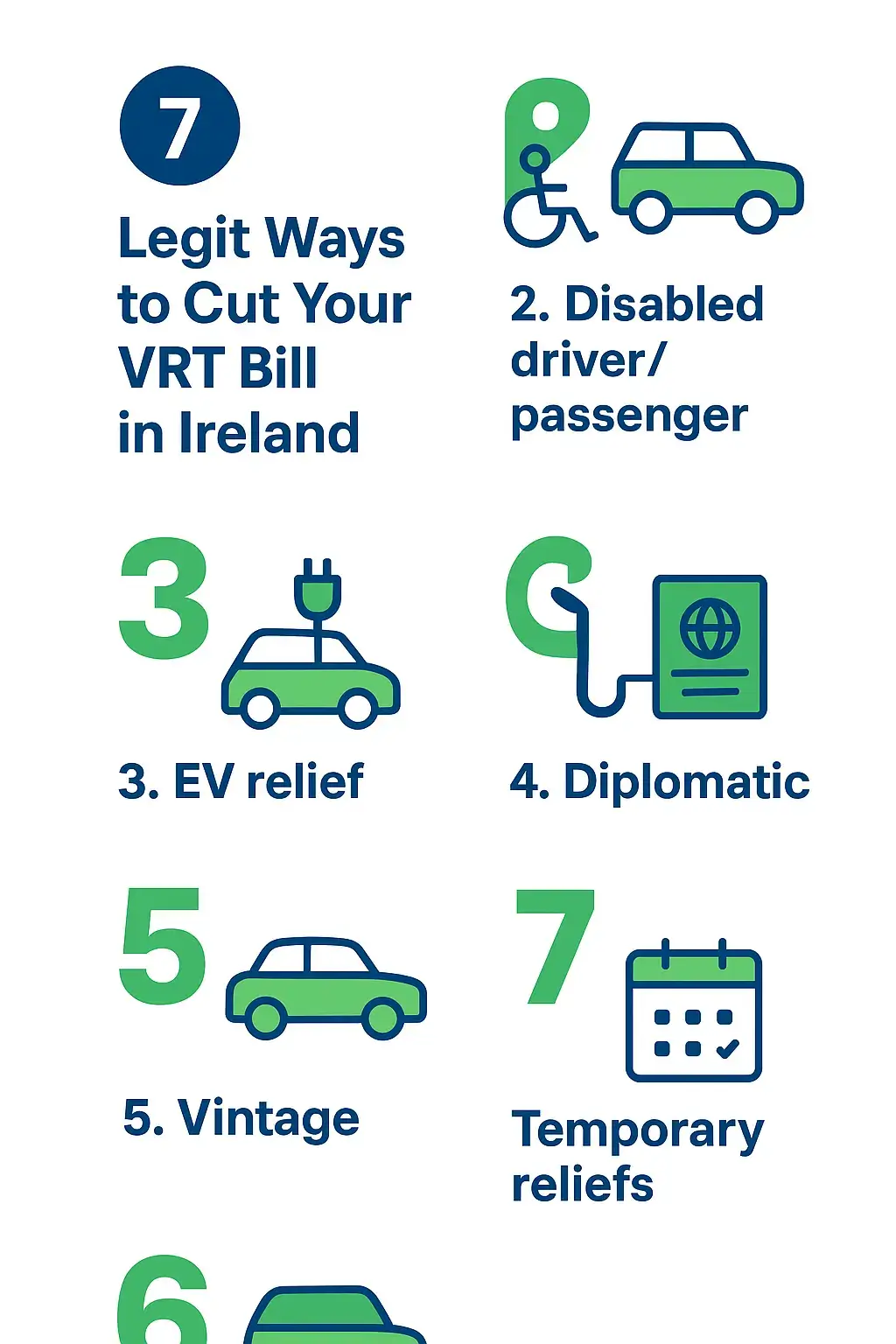
This one is huge for people who qualify, and it's more generous than most people realise. The Disabled Drivers and Disabled Passengers Scheme offers substantial relief on both VRT and VAT for adapted vehicles. We're talking potentially tens of thousands of euros in savings.
To qualify, you need to meet specific medical criteria. We're not talking about a doctor's note saying you've got a bad back. Revenue has a list of qualifying disabilities, and they're strict about it. The vehicle also needs to be specially adapted - you can't just buy any car and claim the relief.
There are two main categories. Primary medical certificates are for drivers with specific disabilities. They cover things like people who are completely or substantially Without the use of their legs, people who are fully deaf, or people who have a condition that means they need to use a wheelchair. There are other categories too, so check Revenue's list.
The relief amount depends on how much adaptation the vehicle needs. More adaptation means more relief, up to certain caps. And here's the kicker - you generally need to keep the vehicle for at least six years. If you sell it earlier, you'll have to repay some or all of the relief.
I spoke to a woman in Galway who got this relief for her son. She told me the application process took about four months, but it saved her over twelve thousand euros on a wheelchair-accessible MPV. That's real money.
Electric vehicle reliefs
The government wants you driving electric. They've made that pretty clear with the VRT reliefs on EVs. If you're buying or importing an electric car with an OMSP (Open Market Selling Price) of up to 40,000, you can get up to 5,000 off your VRT. Between 40,000 and 50,000, you get a tapered relief. Above 50,000, sorry, nothing.
But here's the thing - these reliefs change. They've been adjusted in budgets before, and they'll be adjusted again. If you're planning to buy an EV, check the current rates on Revenue.ie before you commit. Don't rely on what you heard six months ago.
Electric motorcycles are a different story. Series-production electric motorcycles and e-mopeds are completely exempt from VRT until at least 31 December 2026. After that, who knows? The exemption could be extended, changed, or scrapped. If you're thinking about an electric bike, now might be the time.
Hybrids get some relief too, but less than full EVs. The amount depends on the CO2 emissions and the electric range. A plug-in hybrid with a decent electric range will get more relief than a mild hybrid that barely runs on battery.
Vintage and classic cars
If you're into classic cars, you're in luck. Vehicles that are 30 years or older are generally classified as Category C, which means they get a flat VRT rate. Historically that's been around 200, depending on the vehicle type. Compared to what you'd pay on a modern car worth the same amount, that's basically nothing.
But you need to be careful here. The 30-year rule is based on the car's age from the date of first registration, not from when it was built. And the rules can change. I've seen people buy cars thinking they'd qualify for the vintage rate, only to find Revenue had updated their classification system. Check before you buy.
Also, make sure the car genuinely qualifies. Some modified classic cars might not meet the criteria. Revenue looks at whether the vehicle is of historical interest and in its original condition. A heavily modified Ford Escort from 1990 might not cut it.
Diplomatic and international organisation exemptions
This one's pretty niche, but it's worth mentioning. Diplomats and staff of certain international organisations can qualify for full VRT exemptions. If you're working for an embassy or a recognised international body, you might be able to bring in a car tax-free.
The rules depend on the specific international agreement and your status. You'll need official paperwork from your organisation and probably from the Department of Foreign Affairs too. This isn't something you can sort out over the counter at your local Revenue office.
Agricultural and commercial vehicle reliefs
Agricultural vehicles like tractors and certain farm machinery can qualify for VRT exemptions too. But you need to prove the vehicle will be used exclusively for agricultural purposes. If you buy a tractor and use it for the school run, Revenue will notice.
Commercial vehicles get a different treatment under VRT. Most commercial vehicles are charged a flat rate, which is usually lower than what you'd pay on a passenger car of similar value. But the definition of a commercial vehicle is strict - it needs to be designed primarily for carrying goods, not people.
I've seen people try to register MPVs as commercial vehicles to save on VRT. Revenue has seen that trick before. They'll check the vehicle's specifications and classification. If it's got rear seats and windows, it's probably a passenger vehicle, regardless of what you plan to use it for.
Medical equipment and specialised vehicles
Vehicles that are permanently adapted for medical purposes can qualify for VRT relief too. We're talking about things like ambulances, mobile clinics, or vehicles modified to carry medical equipment. If the vehicle's primary purpose is medical, you might not have to pay VRT.
The key word is permanently. You can't buy an ordinary car, throw a first aid kit in the back, and call it a medical vehicle. Revenue will want to see that the vehicle was constructed or permanently adapted for medical use.
How to actually apply with Revenue
Right, so you think you qualify for something. What now?
First, don't leave it until the last minute. Revenue's application processes take time, and if you get it wrong, you'll have to start again. Start gathering your documents at least a month before you plan to import or register the vehicle.
Most applications go through Revenue's online services - myAccount for individuals, ROS for businesses and agents. You'll need to fill in the relevant forms and upload your supporting documents. For some reliefs, you might need to post originals or certified copies.
The documents you'll typically need:
- Proof of identity (passport, driving licence)
- Proof of residence abroad (utility bills, tenancy agreements, employment contracts)
- Vehicle registration document from the country of origin
- Proof of purchase and ownership
- Certificate of Conformity or equivalent
- Medical evidence (for disability schemes)
- Evidence of vehicle adaptations (for disability or medical schemes)
Here's the thing about Revenue. They're not trying to catch you out, but they will reject applications that don't have the right paperwork. I've seen applications rejected because someone submitted a scan instead of a certified copy, or because their proof of residence was one month short of the requirement.
The onus of proof is on you, the applicant. Revenue doesn't have to prove you qualify. You have to prove you do. That's why documentation matters so much. Every piece of evidence you provide should be clear, dated, and verifiable. If there's any ambiguity, Revenue will err on the side of rejecting the application.
Certified copies are a specific requirement for many reliefs. You can't just photocopy your documents and call it a day. You need to have them certified by a solicitor, a notary public, or sometimes by the issuing authority. The cost is usually modest, maybe 10 to 20 per document, but it adds up. Factor that into your budget.
The appeals process explained
If Revenue rejects your application, don't panic. You have options. The first step is to write to Revenue explaining why you think the decision was wrong. Include any additional evidence you didn't submit the first time. Be specific about which part of the decision you're disputing and why.
Revenue will review your appeal and issue a new decision. If they still reject it, you can take your case to the Tax Appeals Commission, which is independent of Revenue. The Commission will hear your case and make a binding decision. The process takes time, and there are no guarantees, but it's worth pursuing if you genuinely believe you qualify.
I've seen appeals succeed because someone realised they had the right documents after all, they just didn't submit them the first time. I've also seen appeals fail because the person simply didn't meet the criteria, no matter how much evidence they provided. Be honest with yourself about whether you actually qualify before you start the appeals process.
Real scenarios and how they played out
Let me walk you through some real situations I've seen, with names changed, to show you how these reliefs work in practice.
Sarah, returning from Dubai. Sarah lived in Dubai for four years and owned her BMW for two of those years. She moved back to Dublin in March and brought the car in within the 12-month window. Her ToR application was approved in six weeks. She saved 4,200 in VRT. The key to her success was having every utility bill, every tenancy agreement, and every payslip from her entire time in Dubai. She kept everything organised in a folder, and she was meticulous about dates.
Michael, the classic car enthusiast. Michael bought a 1992 Mazda MX-5 in the UK, thinking it would qualify for the 200 vintage rate. When he went to register it, Revenue classified it differently because the car had been modified with aftermarket wheels and a roll cage. He ended up paying standard VRT, which was about 1,500. If he'd bought an unmodified example, he'd have saved the difference.
Ciara, disabled driver scheme. Ciara's son needs a wheelchair-adapted vehicle. She applied for the disabled drivers scheme with full medical documentation and a detailed adaptation plan from a specialist converter. The application took about four months, but she saved over 12,000 on a new MPV. The key was getting the Primary Medical Certificate before she bought the vehicle.
These examples show the range of outcomes. When it works, it really works. When it doesn't, it's usually because of a detail that could have been caught earlier.
How Revenue verifies your application
Revenue doesn't just take your word for it. They cross-reference your documents with other data sources. They check your travel history through passport records. They check your employment history through tax records. They check the vehicle's history through international databases.
If you're applying for ToR, Revenue can check exactly when you left Ireland and when you came back. If your application says you lived abroad for 12 months but your passport shows you were back in Ireland for a two-week holiday in the middle, that could be a problem. The rules say you need to have lived outside Ireland for 12 continuous months, and a holiday back home can break the continuity.
This isn't about Revenue being unfair. It's about them making sure the reliefs go to the people who genuinely need them. If you're honest and accurate in your application, you have nothing to worry about. If you try to stretch the truth, they'll find out.
Can you apply after paying VRT?
This comes up a lot. You import a car, pay the VRT, and then discover you could have claimed a relief. Can you get your money back?
In some cases, yes. Revenue does allow for retrospective applications in certain circumstances. But don't count on it. The rules are much stricter for retrospective claims, and the success rate is lower. You'll need to prove not just that you qualified for the relief, but that you had a valid reason for not applying at the time.
My advice is always to apply before you pay. Once the money has left your account, getting it back is an uphill battle. A pre-approval from Revenue is worth its weight in gold.
Time limits that will catch you out
Every relief has time limits, and they're not flexible. For ToR, you have 12 months from the date you move back to bring the car in. For the disabled drivers scheme, you need to apply before you buy the vehicle in some cases. For EVs, the relief is tied to the budget cycle.
Missing a deadline is the most common reason applications get rejected. Not because the person didn't qualify, but because they didn't move fast enough. Revenue won't give you an extension just because you were busy.
My advice? Set a calendar reminder. If you're moving back in June, you need the car in Ireland by the following June at the latest. If you're planning to buy a car and claim a relief, apply before you hand over the money.
Medical equipment vehicles and how they're treated
I mentioned the disabled drivers scheme, but there's a separate category for vehicles adapted for medical reasons. These aren't just for the driver's disability. They can cover vehicles used to transport medical equipment, or vehicles modified for someone with a specific medical condition.
Revenue looks at these on a case-by-case basis. If the vehicle's primary purpose is medical, and it's been permanently adapted for that purpose, you might qualify for a relief or even a full exemption. The key word is permanently. A temporary modification or a vehicle that can easily be converted back to normal use won't qualify.
Examples include vehicles adapted with lifts for wheelchair access, vehicles with specialised seating for people with certain spinal conditions, and vehicles modified to carry life-support equipment. Each case is assessed individually, and Revenue will want to see medical evidence and technical specifications.
Classic car exemptions in detail
I touched on the vintage vehicle rate earlier, but there's more to it than just the flat VRT charge. Revenue classifies vehicles based on their age and condition. Category C is the classification for vehicles that are 30 years or older, and it comes with the reduced VRT rate.
But here's something a lot of people don't realise. The 30-year clock starts from the date of first registration, not from when the car was built. So a 1994 car built in 1993 but first registered in 1994 doesn't hit the 30-year mark until 2024. If you're buying a classic car specifically to get the reduced VRT, check the registration date carefully.
There's also a distinction between a vintage car and a classic car in Revenue's eyes. A vintage car is generally one that's 30 years or older. A classic car might be younger but is considered of historical interest. The rules for classic cars can be different, and they don't always qualify for the same reliefs.
If you're serious about importing a classic or vintage car, I'd recommend getting written confirmation from Revenue about the classification before you buy. A 200 confirmation can save you thousands, but a misunderstanding about the classification could cost you just as much.
What happens if you get it wrong
Let's say you claim ToR relief, bring in your car, then sell it eight months later because you found a better one. Revenue will come after you for the full VRT amount you should have paid. Plus interest, probably.
Same with the disabled drivers scheme. If you sell the adapted vehicle within the retention period, you'll have to repay the relief. And if you're found to have provided false or misleading information, that's a whole different level of trouble.
I'm not saying this to scare you. But Revenue has ways of tracking these things. When you sell a vehicle, the registration transfer is recorded. When you re-register a vehicle, they check its history. Don't think you can slip through the cracks.
Can you combine multiple reliefs?
This is a question I get asked a lot. Can you claim ToR relief and EV relief on the same car? Or the disabled drivers scheme and vintage vehicle rate?
Generally, no. Most reliefs are exclusive. You can't double-dip. If you qualify for ToR, you get the full VRT exemption, so there's nothing left for another relief to reduce. If you qualify for the disabled drivers scheme, you get that specific relief, not a combination of schemes.
But there are edge cases. Sometimes you can choose which relief to apply for, and you'd obviously pick the one that saves you more money. If you qualify for both ToR and the vintage vehicle rate, ToR is probably better because it's a full exemption.
The bottom line
VRT exemptions and reliefs can save you thousands of euros, but you need to do your homework. Read the Revenue guidance carefully. Gather your documents early. Apply before you need to, not when you're already under pressure.
And use a VRT calculator to understand what you'd pay without reliefs, so you can appreciate just how much you're saving. Knowing the baseline number makes the relief feel even better.
If you're not sure whether you qualify, ask. Revenue's website has detailed guides for each relief. You can also contact them directly or speak to a customs agent who deals with vehicle imports. The worst they can say is no, and the best is that you save thousands.
I've seen too many people pay full VRT when they didn't have to. Don't be one of them.
Frequently Asked Questions
Can I claim ToR relief if I owned the car for less than 6 months?
No. You need to have owned and used the vehicle for at least 6 months before your transfer of residence. There are some edge cases for temporary work abroad, but generally, Revenue is strict on this one.
Are electric motorcycles still exempt after 2026?
The exemption runs until 31 December 2026. After that, it could be extended, changed, or allowed to expire. Check Revenue's latest guidance before you buy.
How long do I need to keep a vehicle to keep disability relief?
Some disability reliefs require you to keep the vehicle for up to six years. If you sell it earlier, you'll probably have to repay some or all of the relief.
Can I apply for VRT relief after I've already paid VRT?
In some cases, yes. But it's much better to apply beforehand. If you've already paid and registered, Revenue is less likely to refund you.
Will a vintage car always be 200 VRT?
Historically, yes. But Revenue can change their classification system. Always check the current rules before buying a vintage car specifically to save on VRT.